AI Automation in Supply Chain What to Watch in 2026

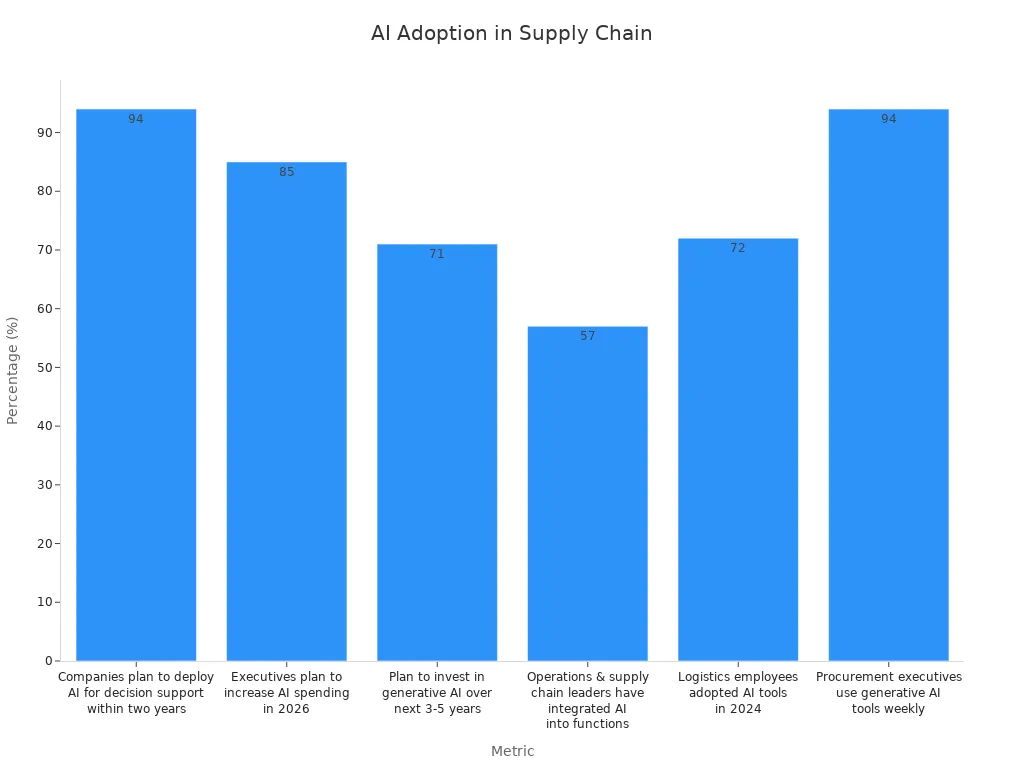
AI automation is no longer a test project. It now runs core supply chain operations. By 2026, this shift will separate leaders from laggards. Which trends will matter most, and why should you act now? ABI Research reports that 94% of companies plan to deploy AI or Gen AI for decision support within two years. That urgency shapes this post. You will learn how predictive analytics, real-time visibility, communication automation, and autonomous trucking change daily work. Each trend affects cost, speed, and customer trust. Waiting means higher costs and slower response times for your team. The window to prepare is closing fast.
How AI Automation Is Reshaping Supply Chain Management
From Rule-Based Tools to Intelligent Systems
Supply chain management is shifting from static rules to adaptive, learning systems. Legacy tools follow fixed instructions. They cannot adjust when demand spikes or routes fail. AI automation changes that. These systems learn from new data and improve over time.
Consider a real example. Argents Express Group faced a surge of 20,000 overnight orders. Their legacy warehouse system could not scale. They adopted a unified platform combining warehouse, order, and integration management. Pack-table productivity rose 57%, from 650 to over 1,100 orders per day. Mis-shipments dropped to zero. This shows how ai in supply chain management moves beyond planning into execution and monitoring.
AI-powered control towers now integrate procurement, manufacturing, and logistics data. They detect anomalies in under 5 minutes, compared to 30-60 minutes without AI. Inventory accuracy reaches 98%, up from 85%. Forecast accuracy climbs to 90%. These gains support supply chain efficiency across your network.
Why 2026 Is a Turning Point
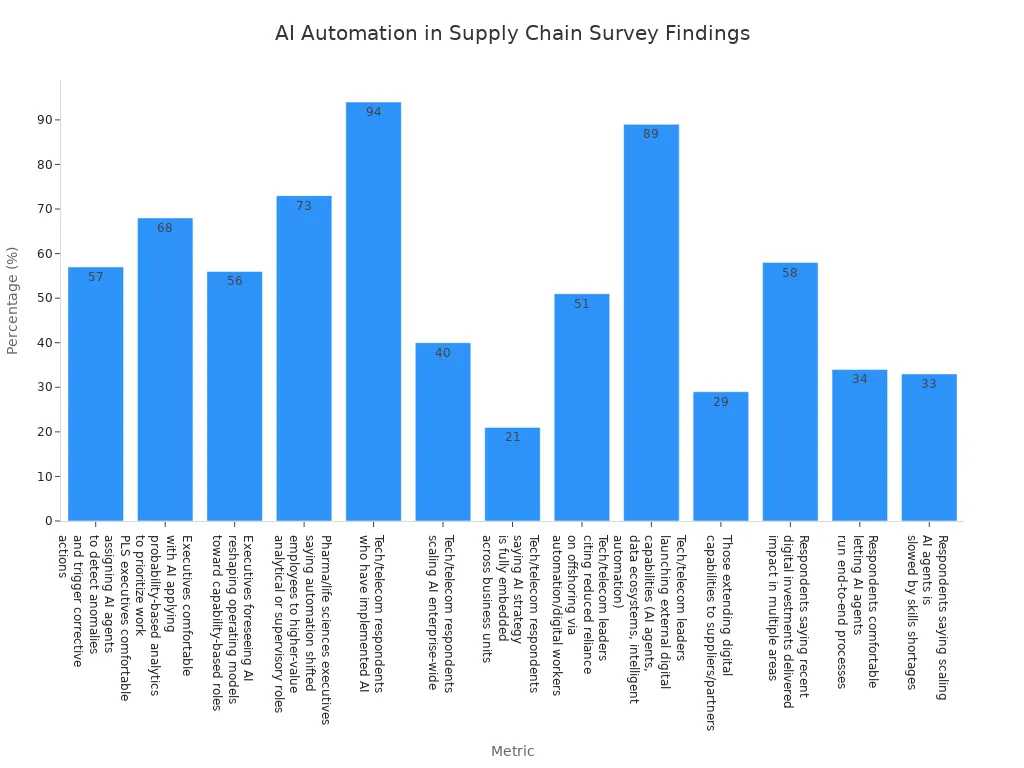
By early 2025, 57% of operations and supply chain leaders had integrated AI into selected functions or throughout their organization. That sets the stage for 2026. By then, AI in logistics will move beyond isolated use cases. It will become deeply embedded across the end-to-end supply chain. Generative AI, autonomous decision-making, and self-learning route optimization will mature into foundational pillars.
However, AI in supply chain management is not plug-and-play. It requires intentional investment. Poor data quality remains a key barrier to digital initiative value for many operations and supply chain leaders. Integration complexity is another common challenge. People capabilities also limit progress. You must invest in master data, unified systems, and talent. Companies are investing in upskilling their workforce on digital technologies.
The shift from predictive to agentic AI will accelerate. Agentic systems decide and act automatically. They transform AI from a reporting tool into an autonomous operational partner. This reduces supply chain disruptions and frees your team for strategic work. The window to prepare is now.
Predictive Analytics in AI in Supply Chain Management
What the Trend Looks Like in 2026
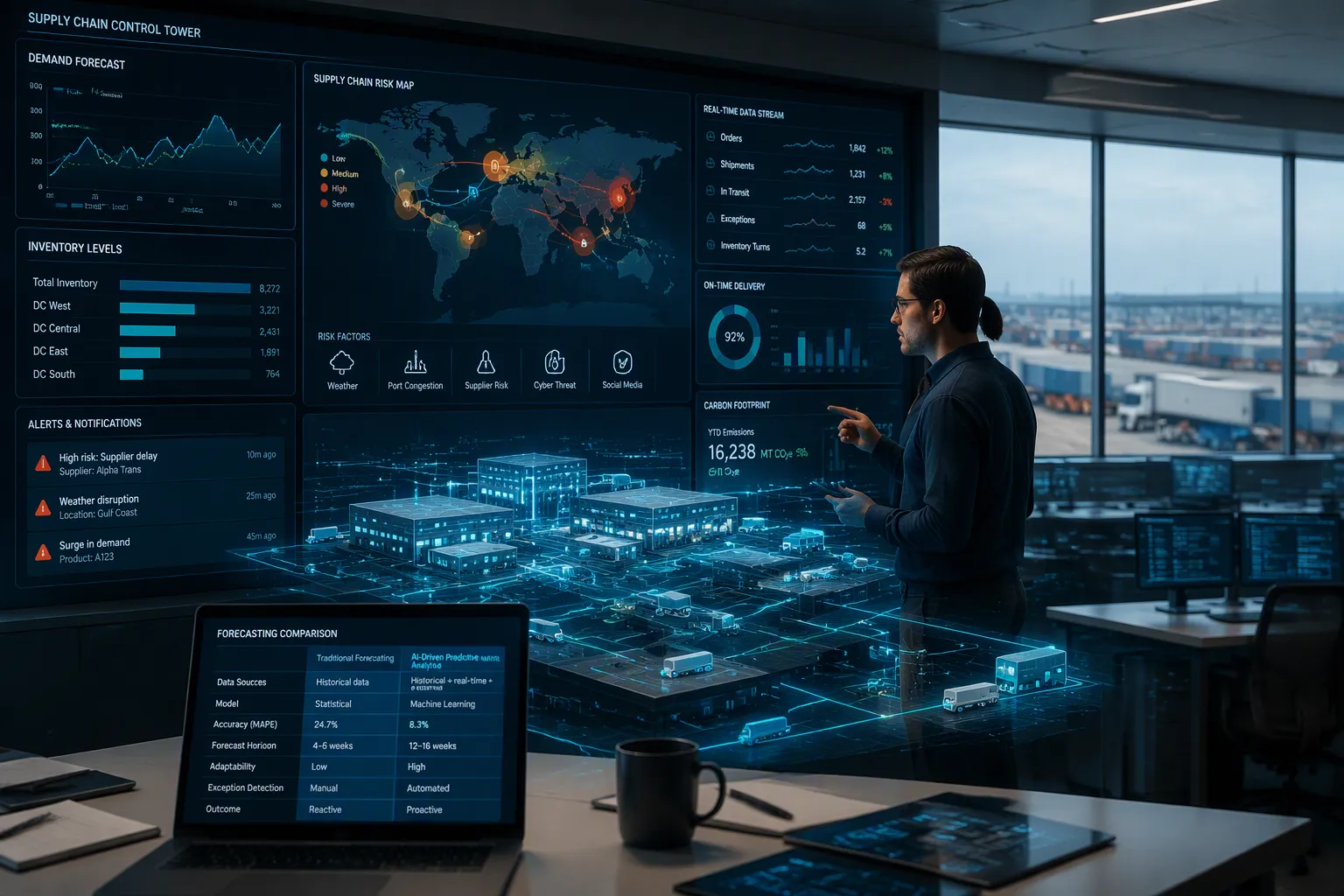
Predictive analytics is moving from forecasting to foresight. Traditional tools rely on historical averages and linear assumptions. They break down in volatile markets. AI-driven systems learn continuously and adapt to new signals.
| Aspect | Traditional Forecasting | AI-Driven Predictive Analytics |
|---|---|---|
| Approach | Static models using historical averages | Machine learning that adapts dynamically |
| Error Reduction | High error rates in volatile conditions | Significantly reduces errors |
| Data Sources | Internal historical data only | Internal and external data (weather, social media, geopolitical factors) |
| Adaptability | Manual recalibration; slow response | Real-time updates and scenario planning |
This shift matters for your team. AI forecasting synthesizes point-of-sale data, weather patterns, and social chatter to deliver SKU-level forecasts in real time. Digital twins let you simulate disruptions and run what-if playbooks before problems hit. You move from reacting to anticipating.
AI-driven forecasting can significantly reduce supply chain errors, leading to fewer lost sales and unavailable products.
By 2026, expect prescriptive analytics and sustainability metrics to guide decisions. Real-time edge analytics will become standard. These tools support ai in supply chain management across planning and execution.
Impact on Inventory, Demand, and Risk
The financial case for ai in supply chain management is strong. Companies with AI-mature supply chains report lower operating costs. Firms implementing AI demand forecasting and inventory optimization see significant reductions in stockout rates.
Case studies show that firms implementing AI-based predictive models achieve reductions in operational costs and increases in revenue growth.
How does this work in practice? AI forecasting automates purchase orders and removes human errors like forgetting to reorder or ordering wrong quantities. It calculates dynamic reorder points by factoring in lead times, supplier reliability, and seasonal demand. When suppliers run late, the system adjusts schedules automatically. During peak demand, it increases order quantities.
For example, Unilever used AI to correlate weather patterns with ice cream sales, leading to improvements in forecast accuracy and sales. This shows how predictive analytics for demand forecasting works at hyperlocal levels.
You can also improve inventory management by letting AI tune buffers continuously. Models trained across your full product portfolio detect correlations between related items and adjust safety stock for both. This reduces excess inventory and storage costs.
Risk management benefits too. AI monitors global signals in real time. It simulates scenarios for port closures, extreme weather, or regulatory changes. You can reroute shipments or secure alternatives before issues escalate. This proactive stance strengthens supply chain efficiency and protects customer trust.
For supply chain management teams, the message is clear. AI for supply chain management is not a luxury. It is a competitive necessity. Companies that adopt ai in supply chain management today will lead tomorrow. The technology works best when built on clean master data and skilled talent. Start with a focused pilot. Prove the value. Then scale across your network.
Real-Time Visibility and AI Automation Reduces Supply Chain Delays
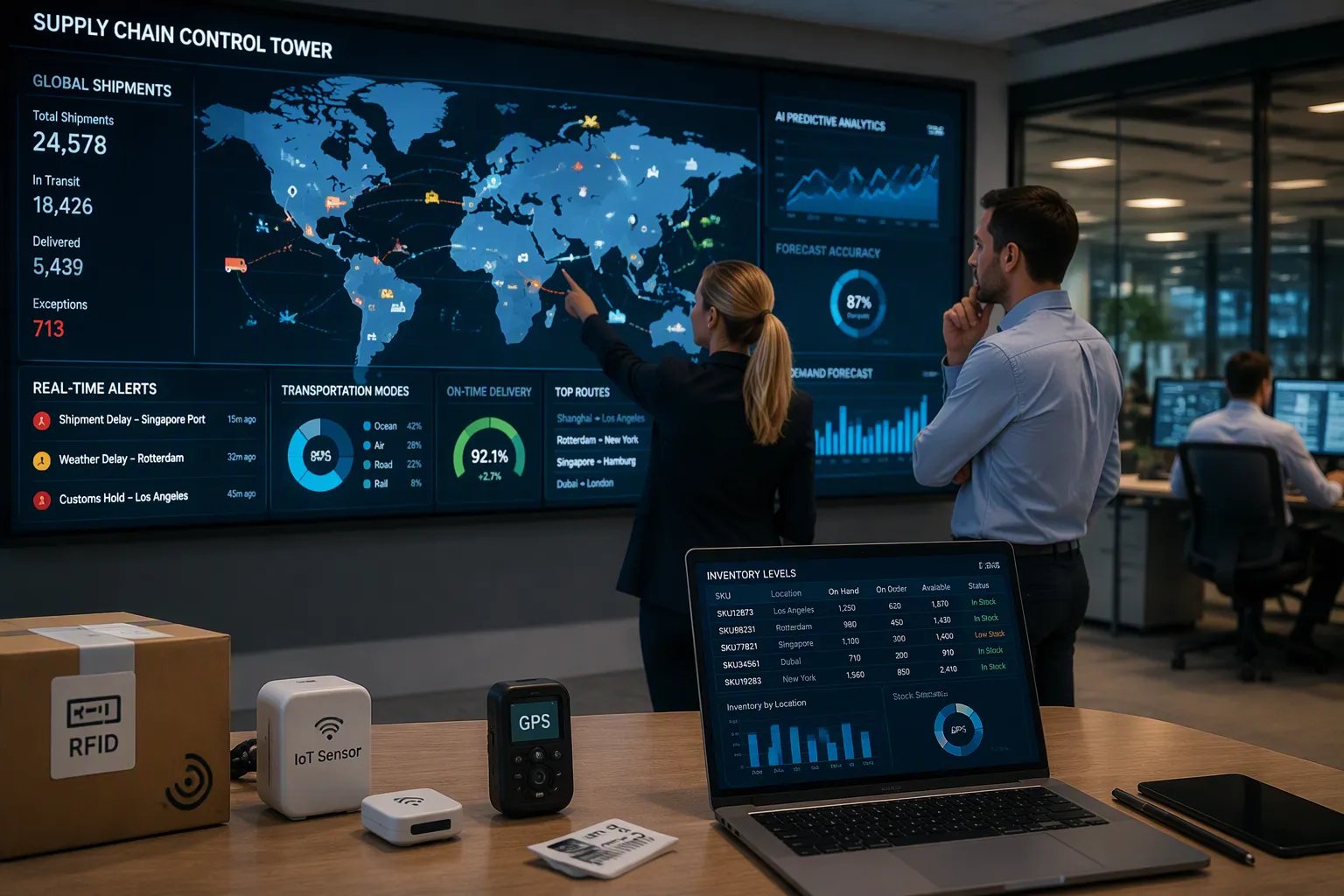
Real-time visibility gives you a live picture of your supply chain every second. You see every shipment, every inventory level, and every supplier action as it happens. When AI processes that data, detection shifts from hours to minutes. This combination of visibility and AI automation reduces supply chain delays directly. Instead of learning about a port closure after trucks arrive, your system alerts you the moment conditions change. For supply chain management teams, this speed matters more each year.
What the Trend Looks Like in 2026
By 2026, visibility into every layer of the supply network will be essential. End-to-end supply chain visibility and AI-driven dynamic orchestration will define supply chain leadership.
IoT devices form the sensory layer of your supply chain. GPS tracking provides real-time vehicle and shipment location. RFID tags automate bulk item tracking. Smart sensors monitor temperature, humidity, and vibration for sensitive goods. This data feeds your AI analysis systems. This combination of real-time tracking and AI gives you a complete operational picture.
A supply chain control tower unifies procurement, manufacturing, and logistics data to strengthen supply chain management. It enhances visibility through end-to-end tracking. It supports proactive risk management by identifying issues before they escalate.
Consider real outcomes from companies using these tools:
| Company | AI Application | Outcome |
|---|---|---|
| Argents Express Group | AI-powered unified platform | Pack-table productivity up 57%, mis-shipments eliminated |
| Maersk | AI to monitor shipping routes and detect disruptions | Real-time alerts and proactive rerouting to reduce delays |
These examples show how ai forecasting works with real-time data. They directly reduce supply chain delays by replacing reactive firefighting with proactive route adjustments. This is how ai in supply chain management moves from reactive to proactive.
A mid-market manufacturer with multiple suppliers chased purchase order acknowledgments manually by email. After implementing AI-powered real-time PO tracking integrated with their ERP, automated follow-ups replaced manual chases. Supplier response rates improved, reducing production stoppages and expedite fees. Instant status updates eliminated visibility gaps.
Impact on Exception Management and Customer Trust
Exception management improves dramatically with real-time monitoring. Electronic information flows from orders through logistics updates. AI validates data for accuracy. An incoming order triggers inventory checks, generates pick lists, schedules shipments, and sends tracking updates. The system continually monitors performance to flag bottlenecks or reroute shipments around disruptions. When demand variability or weather events occur, AI models adjust routes, labor, and schedules in real time. AI automation powers this continuous cycle.
The link between fewer supply chain delays and customer trust is clear. Digital supply chains enhance transparency and decision-making by cutting delays and manual work. This sharpens response times when problems occur. Continuous chain-of-custody data reinforces customer trust and positions you as an industry leader. Customers remember the last time you delivered late. AI helps ensure that memory stays positive.
"AI capability is no longer the constraint; reliability is. Enterprises do not hesitate because AI is weak; they hesitate because AI must earn the right to act."
AI-powered supply chain monitoring earns that trust by delivering consistent, on-time results. Real-time monitoring and supply chain monitoring powered by AI give you visibility into every step. This strengthens your supply chain management strategy. This real-time intelligence is a core capability of ai in supply chain management today.
Communication Automation and Autonomous Trucking in Supply Chain Management
What the Trend Looks Like in 2026
Generative AI boosts communication automation, but it is not a magic bullet. Vendors are embedding Gen AI into daily workflows to automate contract comparisons, generate summaries, and guide users through core processes. However, you must double down on data and talent to see real gains. Clean master data and skilled teams make these tools work effectively.
Autonomous trucking moves into practical deployment for linehaul in 2026. This is a developing area, and its impact on supply chain management is still emerging. Early deployments are expected to focus on hub-to-hub highway corridors.
Impact on Linehaul, Labor, and Cost Structures
These trends reshape supplier, carrier, and customer coordination. AI-powered PO systems automate follow-ups and analyze supplier responses. This helps you optimize supplier management by reducing manual work and improving response rates. The U.S. faces a driver shortage, and autonomous capacity can help maintain scheduled freight movement during periods of limited driver availability. McKinsey research indicates autonomous trucking can cut costs per mile significantly, potentially saving the U.S. trucking sector billions. However, labor savings are not automatic. Remote assistance and roadside response remain operating costs. AI automation in this space directly supports supply chain efficiency. Real-time tracking combined with autonomous routing reduces delays. AI forecasting improves demand planning for linehaul capacity. These tools strengthen your broader supply chain management strategy. AI in supply chain management requires clean data and skilled teams to deliver results. AI in supply chain management rewards early adopters with lower costs and fewer disruptions. AI logistics benefits from improved route planning and reduced fuel consumption.
These four trends converge in 2026. Predictive analytics, real-time visibility, communication automation, and autonomous trucking now work as one system. According to a survey, 94% of companies plan to deploy AI for decision support within two years, indicating widespread adoption by 2026. Early adopters gain a durable advantage.
Companies that aggressively digitize their supply chains can boost annual growth of earnings before interest and taxes — McKinsey
AI automation reduces supply chain delays when you build on clean data. Assess your readiness today. Start a focused pilot. These future trends for ai in supply chain will soon become table stakes. A resilient supply chain depends on acting now.
FAQ
What is AI in supply chain management?
AI in supply chain management uses learning systems to plan, execute, and monitor your network. These tools adapt to new data instead of following fixed rules. They connect procurement, manufacturing, and logistics into one view. You gain faster decisions and fewer surprises.
Which ai in supply chain management use cases deliver the fastest payoff?
Start with demand forecasting and inventory optimization. Companies using AI report lower operating costs and fewer stockouts. Route optimization and exception management follow close behind. These ai in supply chain management examples show value within months, not years.
How does AI improve demand forecasting?
AI reads point-of-sale data, weather, and social signals together. It updates SKU-level forecasts in real time. AI-driven forecasting can significantly reduce errors. Unilever saw improvements in accuracy using this approach.
Do ai-enabled supply chain management solutions replace my planning team?
No. These systems handle repetitive analysis and flag anomalies. Your team focuses on strategy and supplier relationships. You still need clean master data and skilled people. Poor data quality hurt results for many leaders.
What ai applications in supply chain management should I pilot first?
Pick one high-pain area, such as stockouts or late shipments. Run a focused pilot with clear metrics. Prove the value, then scale. According to a survey, 94% of companies plan to deploy AI for decision support within two years, indicating widespread adoption by 2026. Early pilots build the data foundation for ai supply chain management solutions across your network.
See Also
Streamlined Logistics Delivers Speedy And Eco-Friendly Supply Chain Success
Cutting-Edge Technologies Are Revolutionizing Shipping Operations Throughout 2025
How AI Sensors Will Affect Fashion Supply Chains In 2025
Achieving Business Growth Through Outsourced Supply Chain Management Services
EDI Tracking Breakthroughs Are Powering Advanced Shipment Visibility Solutions