AI-Powered Ways to Cut Logistics Costs in Cross-Border Trade

Cross-border logistics costs consume a significant portion of your profit margins. AI technology now delivers measurable cost savings, reducing operational expenses by 15% across international logistics networks. You can achieve this efficiency through five strategic applications: customs compliance automation, route optimization, inventory prediction, warehouse automation, and real-time visibility.
These AI tools transform your supply chain from reactive to proactive. They analyze shipping data instantly, improve customer delivery experiences, and streamline ecommerce operations. The result is cutting logistics costs without sacrificing service quality.
Is your business still manually processing customs documents? If so, you are leaving substantial savings on the table. AI adoption creates a competitive edge in today's demanding cross-border market.
Using AI for Cross-Border Customs Compliance
Customs compliance creates one of the biggest cost pressures in international trade. Manual document processing introduces errors, delays, and penalty risks. AI transforms this process entirely. It automates document classification, reduces classification errors, and keeps you compliant with shifting regulations. You gain direct cost savings across your entire supply chain.
Automating Document Classification
AI systems use Optical Character Recognition (OCR) and Natural Language Processing (NLP) to extract data from documents automatically. These tools read dimensions, weights, and consignee details from email threads, PDFs, or order records. The system then cross-checks product descriptions, values, and origins against global trade data. It automatically flags mismatches, such as a cotton shirt listed under a synthetic customs code. Tools like the WCO's BACUDA project demonstrate this capability by suggesting HS codes and flagging irregularities efficiently. This automation standardizes workflows and speeds document processing significantly.
The accuracy improvement is substantial. AI systems trained on large customs datasets achieve 99% accuracy in HS code classification. This reduces errors to just 1%. Manual processing typically achieves 85-95% accuracy. This difference directly reduces compliance expenses. You face fewer fines, fewer audit hassles, and fewer costly holds. The automation also reduces labor expenses significantly. OCR and NLP eliminate hours of manual data-entry work. Your team focuses on exceptions instead of routine paperwork. This efficiency boost translates directly into cutting logistics costs.
Real-Time Regulatory Updates
Regulations change constantly in cross-border trade. AI systems handle this challenge automatically. The system monitors trade information continuously, not just at filing time. When regulations shift, the system re-evaluates existing records and highlights impacted SKUs. It prioritizes the highest-risk exposures for your review.
The system also checks every shipment, invoice, and supplier name against the latest global sanctions lists in real time. You gain continuous compliance without human intervention. This proactive approach reduces delay-related expenses like storage and demurrage fees. Fewer costly interventions mean smoother operations. Your customers benefit from faster, more reliable deliveries. Your customers also experience fewer disruptions. The combination of automation and real-time data creates a powerful defense against compliance expenses. AI analytics provide deeper insights into your risk exposure.
Optimizing Cross-Border Routes to Cut Logistics Costs
Route planning determines a substantial portion of your transportation expenses. Traditional methods rely on static historical data. They react slowly to disruptions. AI transforms this process entirely. It analyzes weather patterns, fuel prices, port congestion, and geopolitical events in real time. You gain proactive route adjustments that reduce fuel consumption and transit delays.
Dynamic Route Planning with AI
AI-powered engines process multiple data streams simultaneously. They monitor satellite weather feeds, political instability alerts, terminal availability, and conflict escalations. When a storm approaches a major port, the system reroutes your shipment before the disruption occurs. This proactive approach prevents costly delays.
The financial impact is significant. Approximately 55-65% of ships arrive at ports later than expected. These delays cause $5–$10 billion in annual losses. Predictive analytics mitigates this risk by analyzing weather, port congestion, and fuel price data continuously. Since fuel exceeds 50% of total voyage costs, even small route improvements generate substantial savings.
AI also coordinates vessel arrival times with port berth windows. The system optimizes speed and route mid-voyage. This reduces idle time and fuel consumption. The Avathon Autonomy Platform demonstrates this capability. It has optimized billions of barrels of petroleum shipments across thousands of voyages.
Empty miles represent another major cost driver. J.B. Hunt 360 uses predictive algorithms to match drivers with nearby pickups. In 2023 alone, the platform avoided over 4 million empty miles. Since its inception, it has eliminated approximately 17 million empty miles. The algorithms consider driver location, hours of service, preferred lanes, and historical acceptance rates.
Intelligent Carrier Selection
Selecting the right carrier directly impacts your bottom line. AI evaluates carriers across 15+ shipment dimensions. These include weight, value, clearance reliability, and product type. The system analyzes historical network performance to select the best-fit carrier for each shipment.
Flexport's AI agent platform processes over $3 billion in annual freight spend. Their agents analyze shipment performance across 1,000+ carriers. They generate scorecards measuring reliability, cost-competitiveness, and service quality. The results are compelling. AI-driven carrier selection improved on-time delivery rates by 12%. It reduced freight costs by 7% compared to manual procurement.
This shipping automation delivers measurable efficiency gains. Route optimization costs drop by 15-25%. Empty miles fall from approximately 30% to 10-15%. Your customer experiences faster, more reliable delivery. Your logistics operation becomes leaner and more competitive.
Using AI for Cross-Border Ecommerce Inventory
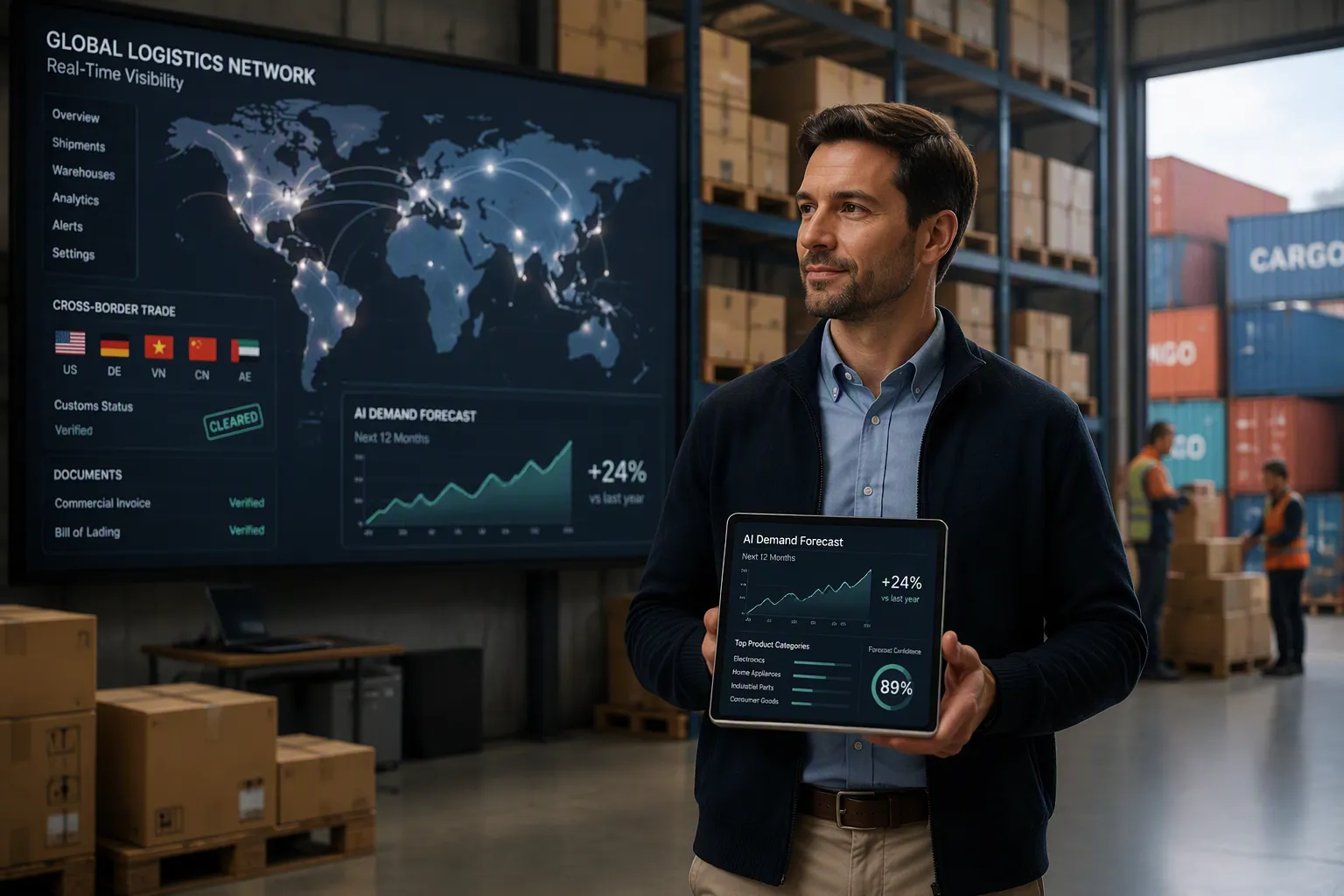
Inventory management in cross-border ecommerce creates unique challenges. You face long lead times, demand variability across markets, and high carrying expenses. AI transforms this situation. It predicts demand with precision. It places stock where it matters most.
Demand Forecasting to Reduce Stockouts
AI-powered demand forecasting analyzes historical sales, seasonal trends, and local market conditions. It identifies patterns humans miss. The system detects that a product sells faster in one region during specific months. It adjusts inventory levels accordingly.
The impact is measurable. AI-powered inventory optimization achieves a 35% reduction in inventory levels. Companies using AI in logistics report a 35% boost in operations. This directly improves service levels in cross-border fulfillment.
AI also enables localized pricing strategies:
| AI Feature | Impact |
|---|---|
| Localized Market Pricing (real-time duties, taxes, shipping, currency conversion per destination) | Brands saw a 13x increase in international conversion rates. |
Your customers see transparent prices. They complete purchases with confidence. Stockouts decrease because you stock the right products.
"AI significantly optimizes the supply chain by predicting demand for better inventory management, reducing waste and costs." This insight confirms that demand prediction is foundational for cross-border ecommerce inventory placement.
Multi-Warehouse Inventory Placement
Placing inventory in the right locations reduces delivery times and shipping expenses. AI models assess demand patterns, shipping times, tariff exposure, and carrier networks. They suggest optimal regional distribution. This approach is key to cutting logistics costs.
Consider Canadian brands shipping internationally. They benefit from fulfilling orders directly from Canada. This approach results in shorter transit times, reduced cross-border fees, and improved customer experience.
The Noir Atelier case demonstrates this approach:
| Aspect | Details |
|---|---|
| Problem | Same-stock allocation ignoring regional demand caused 30%+ split shipments raising logistics expenses by 22% |
| AI Strategy | Unified data layer, regional demand forecasting, and automated replenishment |
| Results | Split shipments dropped by 68%. Logistics cost per order fell by 18%. Stockouts reduced by 47%. Order-to-ship time dropped by 2.1 days. |
This case shows how AI-driven inventory placement minimizes expenses. The efficiency gains are substantial.
The process involves several steps. You consolidate data from sales channels. You forecast demand by location. You segment inventory by velocity. You allocate stock using AI engines. You set dynamic reorder points. You monitor KPIs continuously. This loop keeps your cross-border ecommerce inventory optimized.
The combination of demand forecasting and strategic placement transforms your cross-border ecommerce operation. You reduce waste, improve service, and cut expenses. Your customers receive orders faster. Your business gains a competitive advantage through ai-driven personalization.
Warehouse Automation with AI-Driven Robotics
Warehouse operations consume a large share of your cross-border logistics budget. Labor costs, picking errors, and equipment failures all drive expenses upward. AI-driven robotics transforms this picture. You gain faster operations, fewer mistakes, and lower overhead. The result is a leaner warehouse that supports your international shipping goals.
Automated Sorting and Picking
AI-powered robots handle sorting and picking with remarkable precision. These systems use computer vision and machine learning to identify items, determine their destination, and move them efficiently. You eliminate the human error that causes mis-sorted packages and incorrect shipments. Picking error rates drop dramatically when robots handle repetitive tasks.
The efficiency gains extend beyond accuracy. Robots work continuously without breaks or shifts. They process orders at speeds no human team can match. Your warehouse throughput increases without adding labor hours. This automation directly reduces your operational costs per order. You also gain flexibility during peak seasons. You scale robot fleets up or down based on demand without hiring or training temporary staff.
Predictive Maintenance for Equipment
Equipment breakdowns cause costly downtime in any warehouse. Traditional maintenance follows fixed schedules or waits for failures. Both approaches waste money. AI predictive maintenance changes this equation entirely. You monitor equipment health continuously and address issues before they cause disruptions.
Bosch uses AI to identify maintenance needs for industrial robots, improving equipment reliability and minimizing costly disruptions. DB Schenker applies the same approach to its automated storage and retrieval systems, proactively servicing machinery to avoid unplanned outages. These industry leaders demonstrate the power of predictive maintenance.
The process follows a clear sequence. IoT sensors and Edge AI capture real-time metrics like vibration, temperature, motor current, and acoustic signals. Machine learning models analyze this data to detect abnormalities and predict failure points. The system generates alerts with explainable AI, such as "bearing failure predicted in 12 days due to 5x vibration harmonic increase." Integration with your warehouse management system triggers automated work-order creation, scheduling maintenance during low-activity windows.
The results speak for themselves. AI-enabled predictive maintenance reduces unplanned downtime by 48%. Maintenance costs fall by 35%. One system monitors 800+ conveyors, 250 AGVs, and 1,200 robotic arms simultaneously. Your customer experiences fewer delays. Your shipping automation runs smoothly. This proactive approach keeps your cross-border logistics operation reliable and cost-effective.
Real-Time Visibility for Cross-Border Logistics
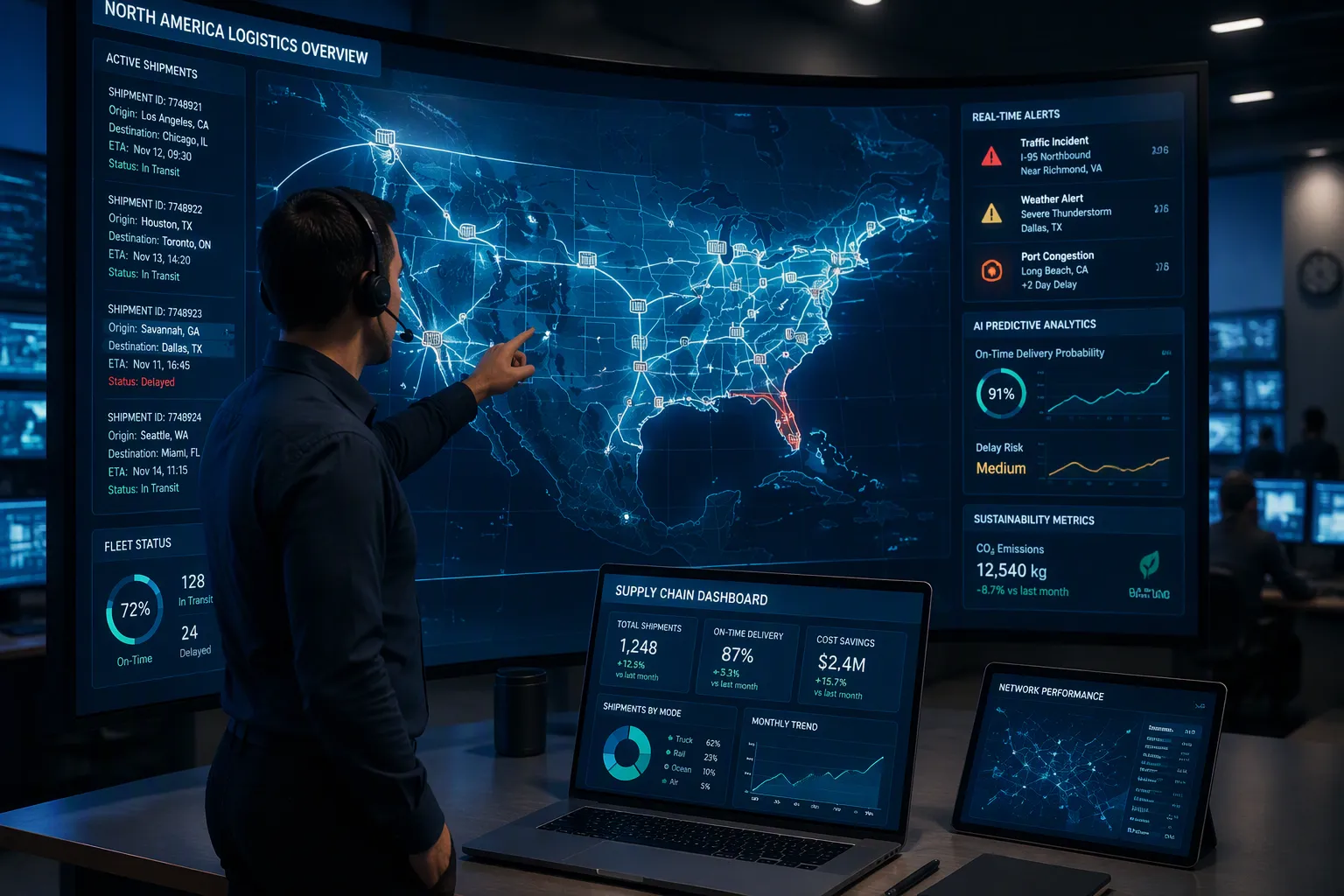
You cannot reduce costs you cannot see. Real-time visibility transforms your cross-border logistics operation from a black box into a transparent system. AI-driven collaboration layers provide early visibility in the US-Mexico-Canada corridor, reducing disruptions before they escalate. Data-driven analysis helps managers identify cost leaks and optimize supply chain decisions.
End-to-End Shipment Tracking
AI-powered control towers standardize shipment data across carriers. They create a single source of truth for every container, route, and shipment variable. IoT-enabled systems provide real-time tracking updates at every checkpoint. You see your freight exactly where it should be, when it should be there.
Nuvocargo's NuvoOS platform demonstrates this capability. It uses a structured data ecosystem with an ETL pipeline feeding a Snowflake warehouse. Machine learning models analyze historical data—traffic patterns, load requests, driver performance—to optimize routes and generate dynamic ETAs. This AI-powered approach achieved $1.2M annual savings for a client by minimizing delays and cutting transportation costs.
Predictive analytics assess variables like lead time, carbon footprint, and costs. Data integration with platforms like Everstream Analytics provides real-time risk insights. AI agents automate event mapping and adapt to API changes automatically. You gain complete visibility across global networks without manual intervention.
Proactive Disruption Management
Real-time tracking alone does not prevent problems. AI must act on the data it collects. The system monitors traffic incidents, weather events, vehicle issues, and loading delays simultaneously. It responds instantly to protect your delivery schedules.
| Factor | AI Response | Impact on Delivery |
|---|---|---|
| Traffic Incidents | Immediate rerouting | Maintains delivery schedules |
| Weather Events | Proactive path changes | Avoids weather-related delays |
| Vehicle Issues | Fleet reallocation | Reduces service interruptions |
| Loading Delays | Schedule optimization | Improves warehouse efficiency |
This proactive approach delivers measurable results. Your customer receives accurate ETAs because AI adjusts them in real-time. Your logistics team focuses on exceptions rather than routine monitoring. The efficiency gains compound across every shipment.
AI-powered product classification systems automatically categorize items using tariff schedules. Predictive analytics assess lead time, carbon footprint, and costs simultaneously. You gain end-to-end visibility by tracking every container, route, and shipment variable across your enterprise. This comprehensive view reveals cost leaks you never knew existed. You optimize supply chain decisions with confidence. Your shipping operation becomes more resilient, responsive, and profitable.
AI delivers measurable results across your cross-border logistics operation. You reduce costs through customs automation, route optimization, inventory prediction, warehouse robotics, and real-time visibility. You gain efficiency while lowering risk exposure simultaneously.
The global AI in logistics market is projected to reach nearly USD 707.75 billion by 2034, growing at over 44% annually. AI has shifted from 'nice-to-have' pilots to mission-critical systems.
Start small. Pilot AI customs tools first. Then expand gradually toward intelligent supply chains. Route optimization cuts fuel consumption by up to 15%. Demand forecasting reduces inventory levels by 15-20%. UPS's ORION system saved 10 million gallons of fuel annually.
Your customer benefits from faster delivery. Your ecommerce operation gains competitive advantage. The 15% cost reduction awaits your action. Explore AI solutions today.
FAQ
How quickly can AI tools integrate with my existing logistics systems?
Most AI platforms connect through APIs without replacing your current software. Implementation typically takes two to six weeks for customs automation or route optimization tools. Your team needs minimal training since these systems work alongside familiar interfaces. You start seeing efficiency gains within the first month of operation.
What is the typical return on investment timeline for AI adoption?
Most businesses recover their AI investment within six to twelve months. Customs compliance automation delivers the fastest returns through reduced penalties and labor costs. Route optimization generates ongoing savings through lower fuel consumption. Your total savings compound as you expand AI across more supply chain functions.
Does AI require massive amounts of historical data to work effectively?
AI systems function with modest datasets, though more data improves accuracy. Even six months of shipping records enables meaningful demand forecasting. For new operations, AI platforms use industry benchmarks and regional patterns as starting points. Your system refines predictions as you accumulate more transaction history.
Can small and mid-sized cross-border ecommerce businesses afford these AI tools?
Yes. Many AI logistics solutions offer tiered pricing based on shipment volume. You can start with a single function like customs document automation for under $500 monthly. This entry point delivers immediate cost reductions that fund further AI expansion. The investment scales with your operational growth.
How does AI improve the customer experience beyond cost reduction?
AI-powered tracking provides your customer with accurate delivery windows instead of vague estimates. Proactive disruption alerts let you notify customers before delays occur. This transparency builds trust and reduces support inquiries. Your customer receives a smoother cross-border ecommerce experience, which drives repeat purchases and positive reviews.
See Also
Efficient Supply Chains Achieve Quick and Eco-Friendly Success
Three Methods for Enhancing Green Supply Chain Through Lean Practices
Cutting-Edge Innovations Revolutionizing Shipping Processes by 2025
Boosting Performance Using Intelligent Ecommerce Warehouse Tactics
Internal Logistics Advances Defining Tomorrow's Storage Facilities