How AI Visual Inspection Is Revolutionizing Quality Control in 2026
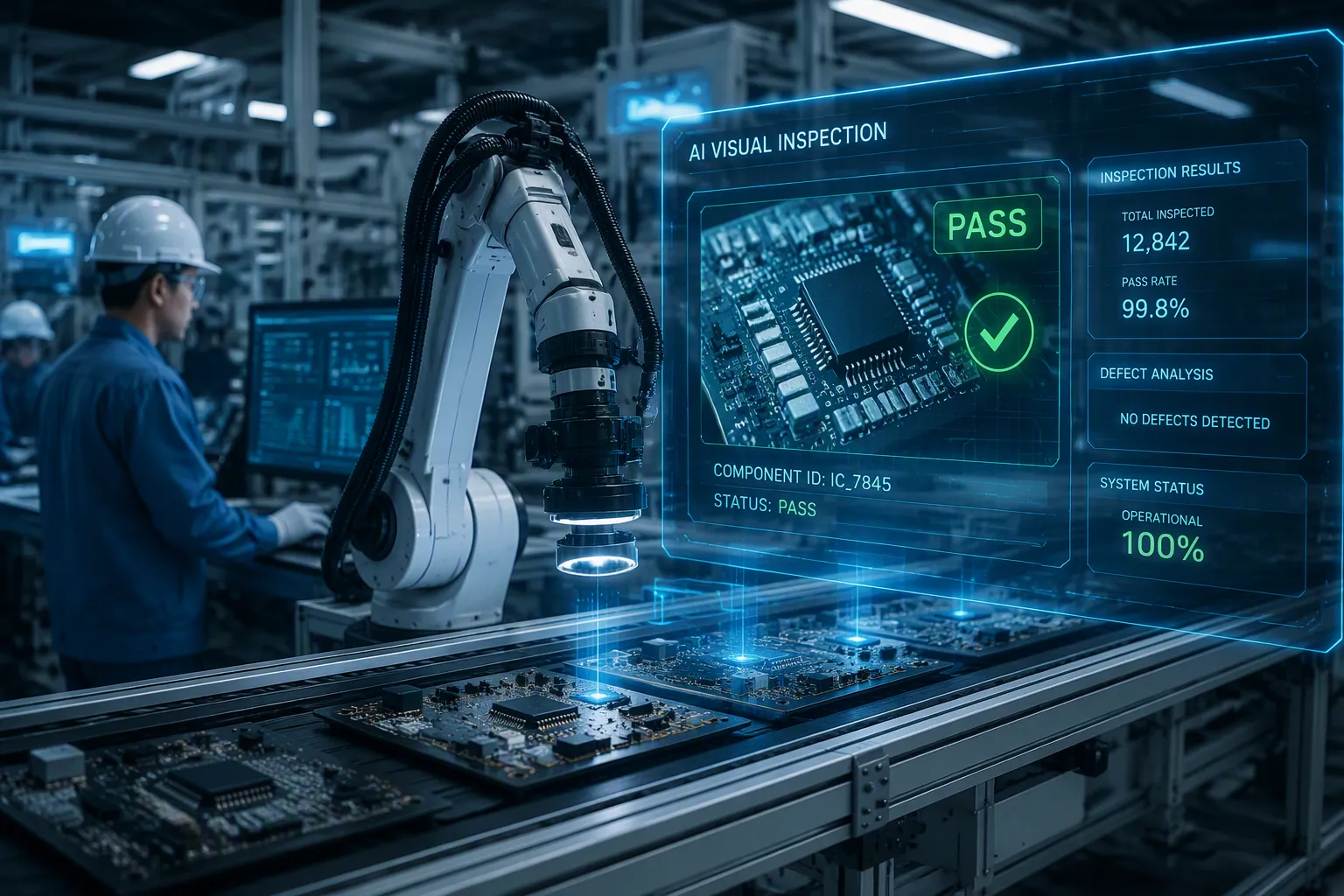
You know the pain of manual quality control: tired eyes, missed defects, slow sampling. What if you could catch every single defect at the speed of your production line, without a single human eye? That’s the promise of AI visual inspection. In 2026, this technology is not an incremental improvement but a fundamental revolution in manufacturing. The market for AI-powered visual inspection is projected to grow from $36.84 billion in 2026 to $85.24 billion by 2030, a compound annual growth rate of 23.3%. This rapid expansion reflects the immense value of automated inspection. Such systems are reshaping how you ensure quality, offering unmatched accuracy and speed. Real-time visual inspection of every product becomes possible. Your production line can now achieve perfect quality with zero human error. The era of AI-powered quality has arrived.
How AI Visual Inspection Works
Core Technologies: Computer Vision and Deep Learning
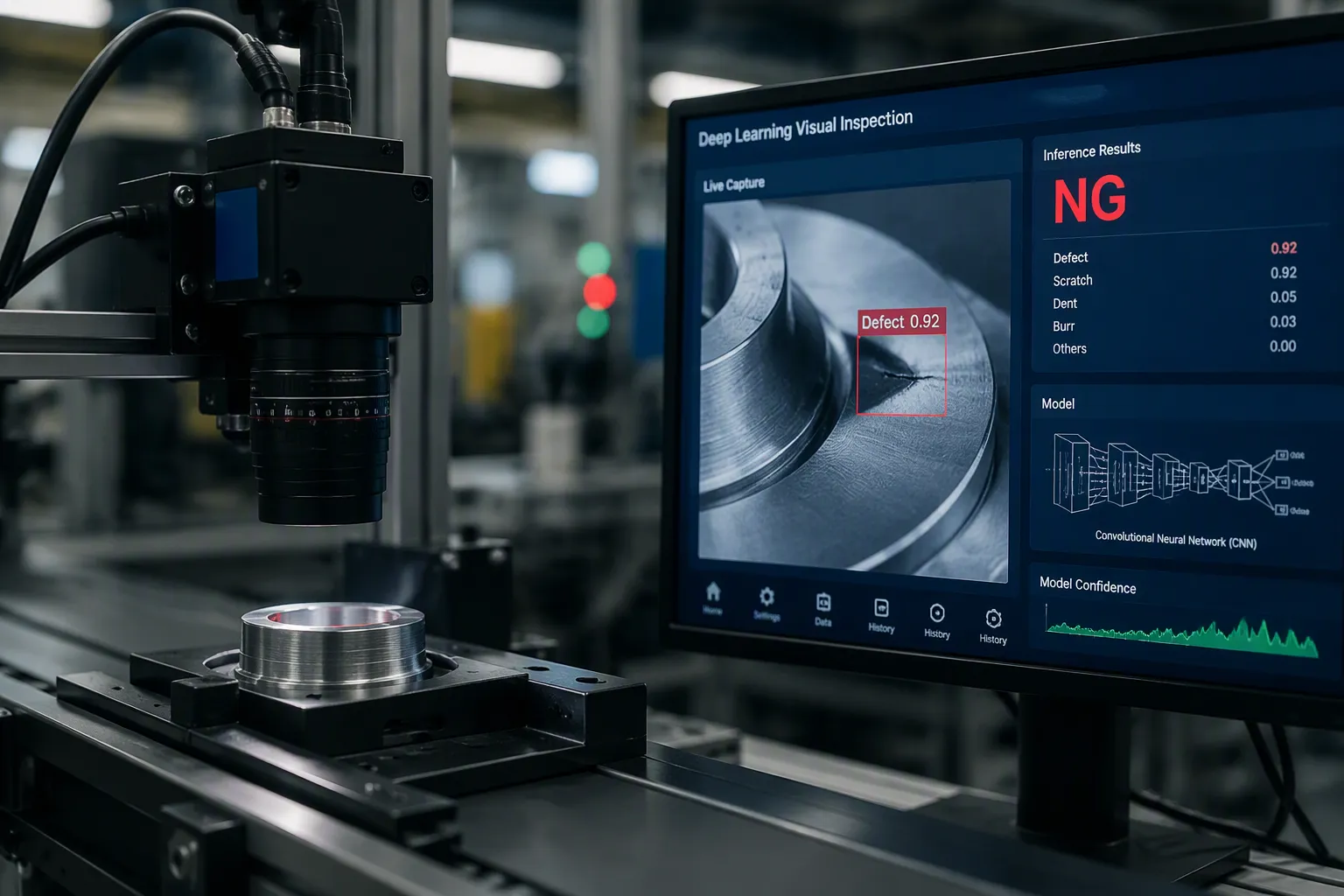
Every AI visual inspection system relies on two core technologies. Computer vision provides the eyes. High-resolution cameras capture detailed visual images of every product. But images alone are not enough. The system needs intelligence to interpret the visual data it captures. That intelligence comes from deep learning.
Convolutional neural networks (CNNs) are the workhorses of modern AI. These networks learn directly from labeled examples. You do not need to manually define what a scratch or dent looks like. The network automatically extracts these features from training data. This eliminates the need for a process engineer to specify every visual mark. The system simply replicates knowledge from labeled images to new ones. This represents a major leap over traditional visual inspection methods. Before CNNs, engineers spent hours on manual feature extraction. They wrote rules for every possible defect. But this approach failed when products showed natural variation.
Now, deep learning models encode statistical patterns. They recognize defects at unexpected locations, orientations, or surface finishes. This enables defect detection of subtle issues like texture irregularities. The result is an inspection system that can handle variable materials like leather grain, textile weave, and coated metals. The model learns the underlying visual signature of defects rather than relying on hardcoded thresholds. This automated detection capability is a game changer for manufacturing quality.
Training these models requires high-quality data. You need at least 50 labeled images per defect class for reliable results. For rare defects, generative AI can produce synthetic images from a few real examples. This approach reduces false rejection rates by up to 9 times compared to models trained solely on real data.
But natural variation in products is a real challenge. Manufacturing involves variable materials, changing products, and natural visual differences. The system must separate natural variation from true defects. A pixel-area threshold below which detected anomalies are not promoted to production alerts helps eliminate 20 to 40 percent of false positives. You can also calibrate separate confidence thresholds per defect class. This method ensures the system catches genuine defects without flagging acceptable variation.
From Training to Deployment: The Workflow of an AI Inspector
The path from raw data to a deployed AI inspector follows a clear workflow. It starts with data collection. You capture images under consistent conditions. Uniform lighting, camera angles, and resolution are critical. Optimal lighting configurations like low-angle, backlighting, dome, and strobe lighting help highlight defects. This automated visual inspection approach eliminates many of the variables that plague manual inspection.
Next comes data labeling and preparation. You label each image as defective or non-defective. Exploratory Data Analysis (EDA) cleans the data and removes bias. A balanced dataset is crucial for the AI to generalize accurately across different products and defect types. The AI inspection model learns to distinguish subtle differences during this phase.
Then you train the model. You split data into training, validation, and testing sets. A loss function compares target and predicted outputs, driving the model to improve accuracy. This is supervised learning. It requires labeled data but delivers higher accuracy for specific classification tasks. The AI inspection system becomes more reliable with each training cycle.
After training, you deploy the model on edge devices like NVIDIA Jetson. The system integrates with PLCs to trigger automated rejection of defective products. Real-time analysis happens at line speed. Every product gets a thorough inspection, not just a sample. This real-time defect detection capability ensures no defective product leaves your line. The AI visual inspection system processes thousands of images per minute.
The system improves over time. It learns from new production data. It can detect new defect types as they appear. This continuous improvement makes AI-powered visual inspection a long-term investment. The system also supports monitoring of production quality trends. You gain visibility into your entire process. Your entire AI-powered visual inspection workflow becomes smarter and more accurate. This is the power of artificial intelligence in industrial quality control. The AI adapts to your changing production needs and learns new visual patterns.
Key Benefits of Automated Visual Inspection
Achieving Unprecedented Accuracy and Speed
The most compelling reason to adopt automated visual inspection comes down to numbers. Manual inspection catches only 80-85% of defects, and that rate drops after just 20-30 minutes of continuous work. Human eyes tire. Attention wanders. Your best inspector on their best day cannot match what AI achieves every single shift.
AI-powered visual inspection systems sustain detection rates above 99% for well-defined defect classes, without fatigue-related performance degradation. Consider a real example from an Electronics OEM. After implementing AI inspection, their defect escape rate fell from 2.3% to 0.1%. That represents a 95.65% reduction in defective products reaching customers. A steel plant saw similar results, cutting out-of-spec coils by 94%.
The speed difference transforms your production economics. A human inspector processes 10-50 parts per hour. An AI vision system examines 1,000+ parts per hour, processing each part in under 100 milliseconds. That is 20 times more parts inspected with greater accuracy. Your line never slows down for quality checks. Every product receives the same thorough examination, from the first unit of the morning shift to the last unit before maintenance.
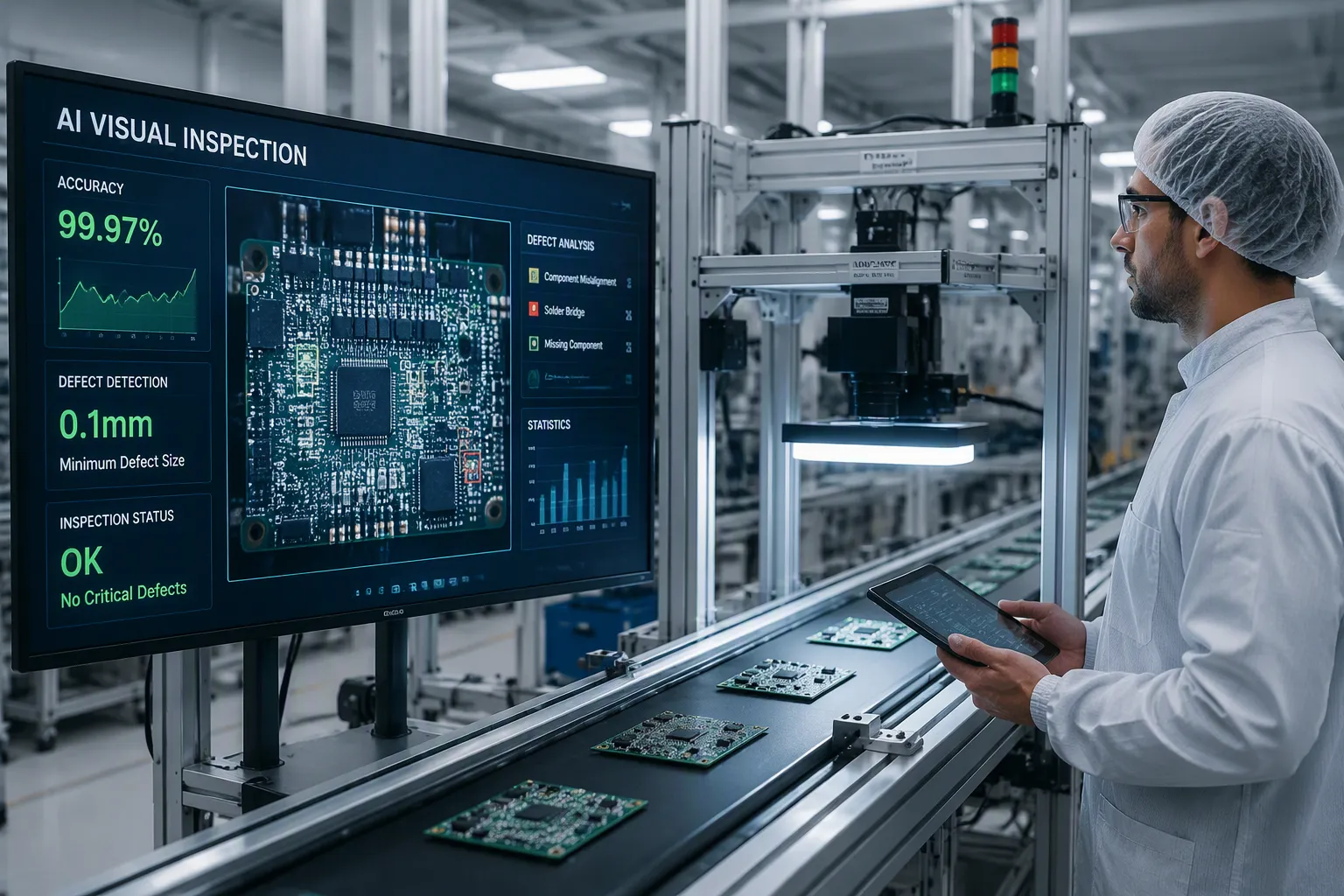
State-of-the-art systems in 2026 achieve remarkable accuracy levels. The Consumer Technology Association reported 99.97% accuracy for PCB solder joint inspection. General AI vision systems detect surface defects as small as 0.1mm with 99%+ accuracy. Expert reviews across automotive, electronics, and food industries confirm 95-99% accuracy at full production speed. This improved accuracy and consistency means fewer recalls, fewer customer complaints, and stronger brand reputation.
The consistency factor matters as much as raw speed. Human inspectors show natural variation between individuals and across shifts. AI inspection delivers identical standards at 2:00 AM and 2:00 PM. Your quality control becomes truly consistent quality control, independent of human factors.
Reducing Costs and Enhancing Scalability
The financial case for AI-powered visual inspection grows stronger with each deployment. Companies report 30-70% fewer defect escapes, directly reducing warranty claims and customer returns. Scrap and rework costs drop by 10-30% because defective products get caught early in the process. Most organizations achieve their return on investment within 6-12 months.
The cost savings extend beyond defect reduction. AI inspection eliminates the need for dedicated inspection stations staffed by multiple workers. One system monitors your entire line continuously. Your existing staff can focus on value-added tasks instead of repetitive visual checks. This automated detection capability reduces labor costs while improving outcomes.
Integration with existing systems amplifies these benefits. Companies that connected AI inspection with MES and ERP software saw a 25% improvement in production efficiency. Those that failed to integrate properly faced delays and wasted their investment. The lesson is clear: plan your integration early and involve your IT team from the start.
Deployment speed surprises most manufacturers. For initial proof-of-concept setups, you can expect results within 1-4 hours depending on complexity. Many customers move from pilot to full production in less than two days. Model training from labeled data takes approximately 30 minutes. Site Acceptance Testing completes in as few as 5 days. Full production deployment on a single line happens within 7 days.
The scalability of AI inspection deserves attention. You can deploy one system on a single line, then expand across your entire facility. The same model architecture works for different products with minimal retraining. Systems that adapt to new products or defect types reduced setup time by 70%. This flexibility makes AI inspection a strategic investment, not just a tactical fix.
Employee training and engagement determine success. Firms that involved quality control staff in development achieved 30% faster implementation. Your team becomes part of the solution rather than resisting change. They learn to interpret AI alerts, handle edge cases, and continuously improve the system. This collaboration between human expertise and artificial intelligence creates the strongest quality program.
The evidence points to one conclusion. AI visual inspection delivers measurable improvements in accuracy, speed, and cost that manual methods cannot match. The technology pays for itself quickly and keeps delivering value through continuous learning and adaptation.
Real-World AI-Powered Visual Inspection Applications
Transforming Industries from Automotive to Electronics
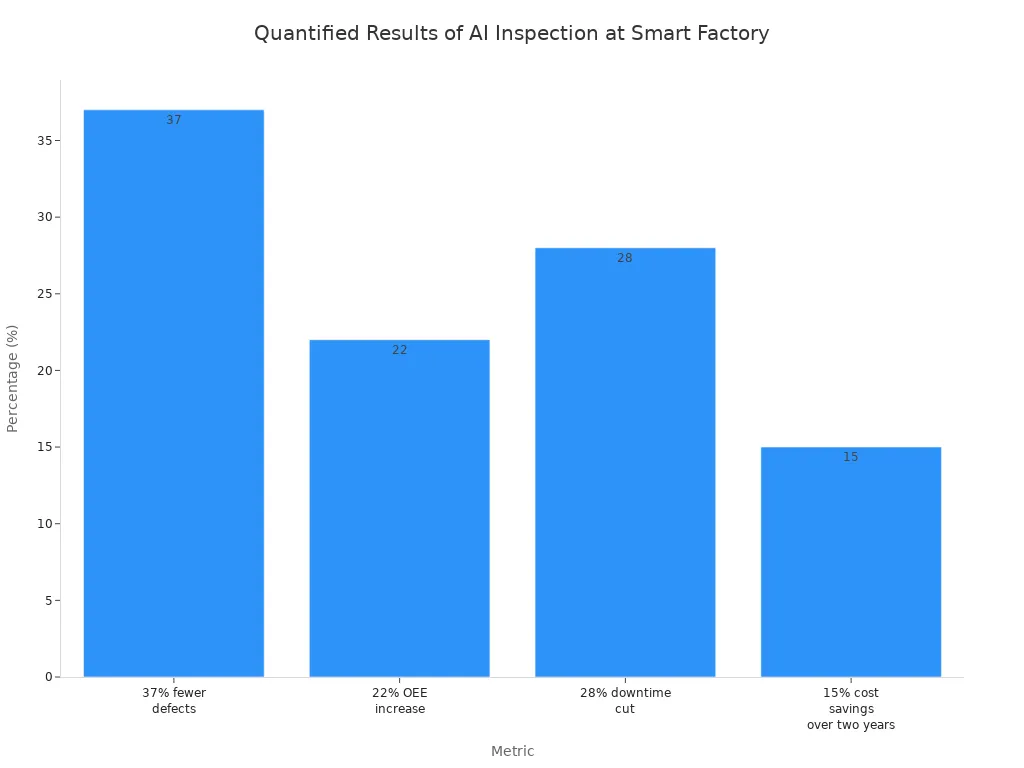
AI is reshaping manufacturing quality control. The technology delivers enhanced safety and workplace safety in industrial settings. AI-powered remote visual inspection of welds keeps workers away from hazards. BMW's approach reduced flaws by 40%. An automotive components smart factory reported 37% fewer defects, a 22% OEE increase, and 28% less downtime. Catching defects early prevents downstream failures. This approach improves overall safety.
Electronics manufacturers see similar gains. Solder joints achieve 99.97% accuracy. One semiconductor maker reduced its defect escape rate from 2.3% to 0.1%. Each 0.1% yield improvement generates $75 million. Warranty savings reach $1.8 million per line annually. Intel saves $2 million each year. Remote visual inspection of wafer surfaces detects micro-defects.
Deep Learning AI-based classifiers increase accuracy in defect classification for both existing and newly found defect types from an assortment of wafer designs. This directly addresses the challenge of detecting micro-defects that are invisible to optical microscopy and too subtle for manual or rule-based classification.
Semiconductor manufacturers use AI-driven automated remote visual inspection systems for hidden structures. These layers are invisible to optical cameras. The system automates void quantification and pattern recognition.
Food processors benefit from visual inspection methods. Remote visual inspection of food products catches contaminants like plastics, rubber, and glass. Food safety improves through AI detection. Metal detection cannot see plastics. X-ray struggles with thin glass fragments. This technology fills that gap.
"Foreign material detection is not a new subject. It's been going on in the food processing world for a long time. Everybody's being a lot more alert on foreign material, and there's more of a demand or need to look at things like paper, wood chips [and] plastic." — Yuegang Zhao, KPM Analytics
All data and images are stored, providing complete traceability. This is a key differentiator.
A Practical Guide to Integrating AI Inspection
Deploying AI-powered visual inspection systems follows a clear path. Start with a pilot line. Expect results within 1-4 hours. Model training takes about 30 minutes. Full production deployment completes within 7 days.
The financial case is compelling. A typical 3-station DeepVision deployment costs ₹35-55 lakhs. The payback period is 3-4 months. The 3-year ROI exceeds 650%. Median first-year ROI is 300%. Typical payback ranges from 6-18 months. Scrap reduction can reach up to 90%.
False rejection rates matter. Rule-based systems reject 5-15% of good parts. AI-powered systems target ≤1%. On a line producing 500,000 parts per year, reducing FR from 7% to 1% recovers 30,000 good parts. At $10 per part, that equals $300,000.
| Cost Category | Undetected 45 Min | Caught in Real Time by AI |
|---|---|---|
| Vehicles produced with defect | 34 units | 0-1 units |
| Line stoppage for rework triage | 1.75 hours avg | None |
| Production value at risk | $4.0M+ | ~$0 |
| Rework labor hours | 60-90 hrs | 2-5 min per reject |
| Scrap risk (non-reworkable) | High | Near zero |
| Warranty / field exposure | Possible | Eliminated |
Cloud scalability enables multi-site management. Remote visual inspection data enables centralized monitoring across factories. Safety improves through automation. Edge computing provides low-latency detection. This combination allows expansion without re-architecting.
Employee training drives success. Involve your quality control staff. Teams that participated achieved 30% faster implementation. Your workers learn to interpret system alerts. This collaboration between human expertise and artificial intelligence creates the strongest program.
AI visual inspection is no longer optional. It is a strategic necessity for staying competitive in 2026. This AI technology delivers unmatched accuracy, significant cost savings, and scalable operations. These benefits directly address the pain points of traditional quality control. The future of quality is intelligent and automated.
You can start today. Begin with a pilot project. Follow the 90-day phased approach: assess your processes, develop and test the model, and integrate it into production. Choose a vendor with strong integration capabilities and comprehensive support for your visual inspection system. Your team can achieve measurable ROI within months. The era of AI-powered quality control has arrived. Embrace it.
FAQ
How quickly can you deploy an AI visual inspection system?
You can deploy a system in under 7 days. A proof-of-concept takes 1-4 hours. Model training requires about 30 minutes. Site acceptance testing completes in 5 days.
What return on investment can you expect?
Most organizations in industrial settings achieve payback within 6-18 months. The median first-year ROI reaches 300%. A 3-year ROI often exceeds 650%. Scrap reduction can reach up to 90%.
How does the system handle false positives?
The AI inspection system uses a pixel-area threshold to eliminate 20-40% of false positives. You can calibrate separate confidence thresholds per defect class. This keeps false rejections under 1%.
Can the system detect new types of defects?
The system learns from new production data continuously. It can detect new visual defect types as they appear. This enables continuous improvement and monitoring of production quality trends.
How much training data do you need to start?
You need at least 50 labeled images per defect class for reliable results. For rare defects, generative AI can produce synthetic images from a few real examples.
See Also
Cutting-Edge Tech Boosts Warehouse Efficiency By 2025
AI Sensors Revolutionize Fashion Supply Chains In 2025
Standard Procedures Enhance Warehouse Operations In 2025
EDI Advancements Enable Real-Time Shipment Tracking Visibility