Predictive Maintenance With AI A Complete Guide
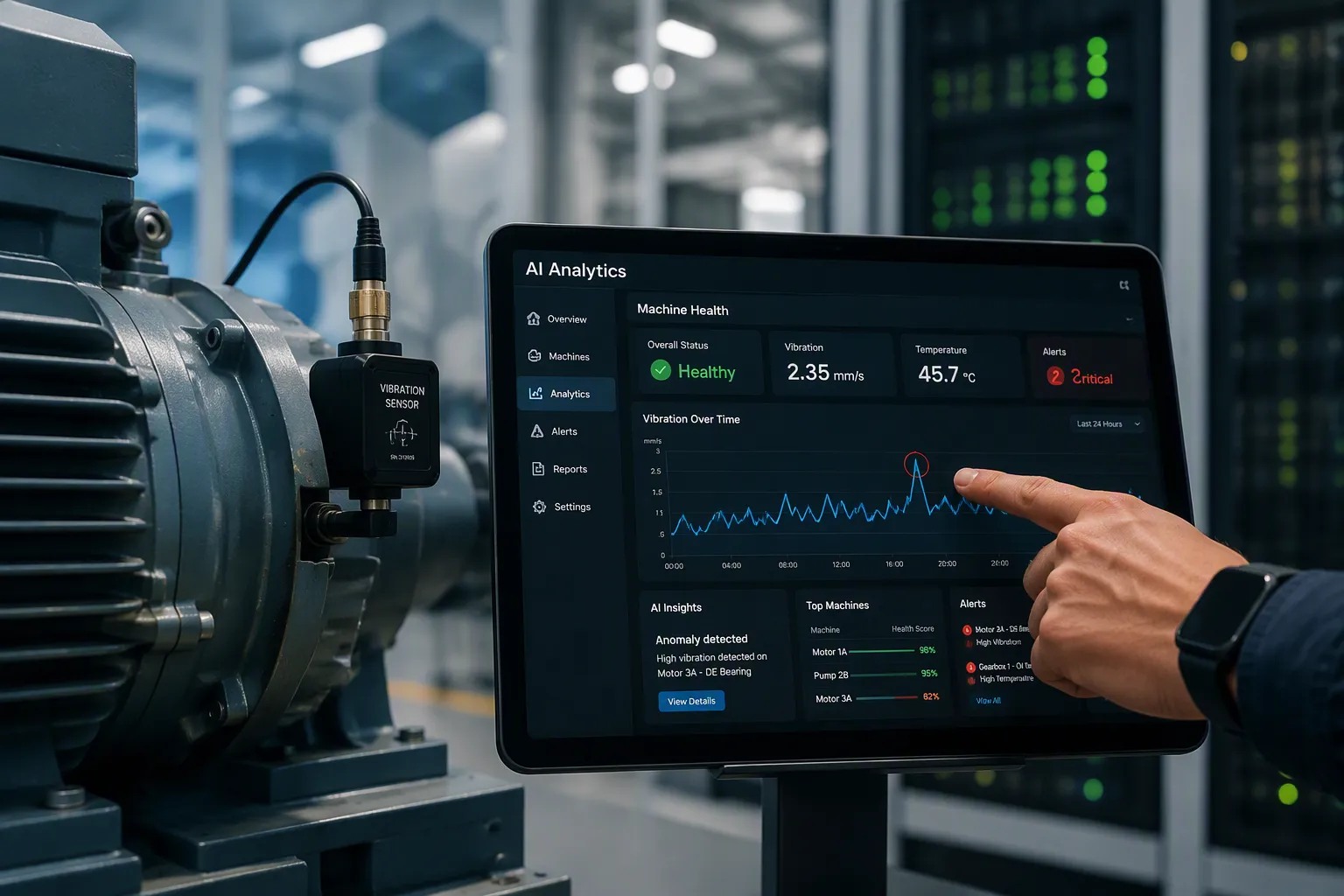
Picture your assembly line grinding to a halt. A critical motor fails without warning. Production stops. Orders delay. Chaos spreads through your facility. This scenario costs you dearly.
AI-powered predictive maintenance changes this story. This proactive strategy uses machine learning to forecast failure before it interrupts your operations. You shift from reacting to problems to preventing them.
The results speak clearly. According to industry data, predictive maintenance reduces unplanned downtime by 30–50%. McKinsey states this approach can cut machine downtime by up to 50%. Your maintenance costs drop 25–30%, breakdowns decrease 70%, and inventory carrying costs fall 15%.
Predictive maintenance transforms reactive firefighting into strategic asset management.
This guide walks you through the complete process, key technologies, and real-world benefits. You'll learn implementation challenges and practical solutions for your organization.
Defining AI-Powered Predictive Maintenance
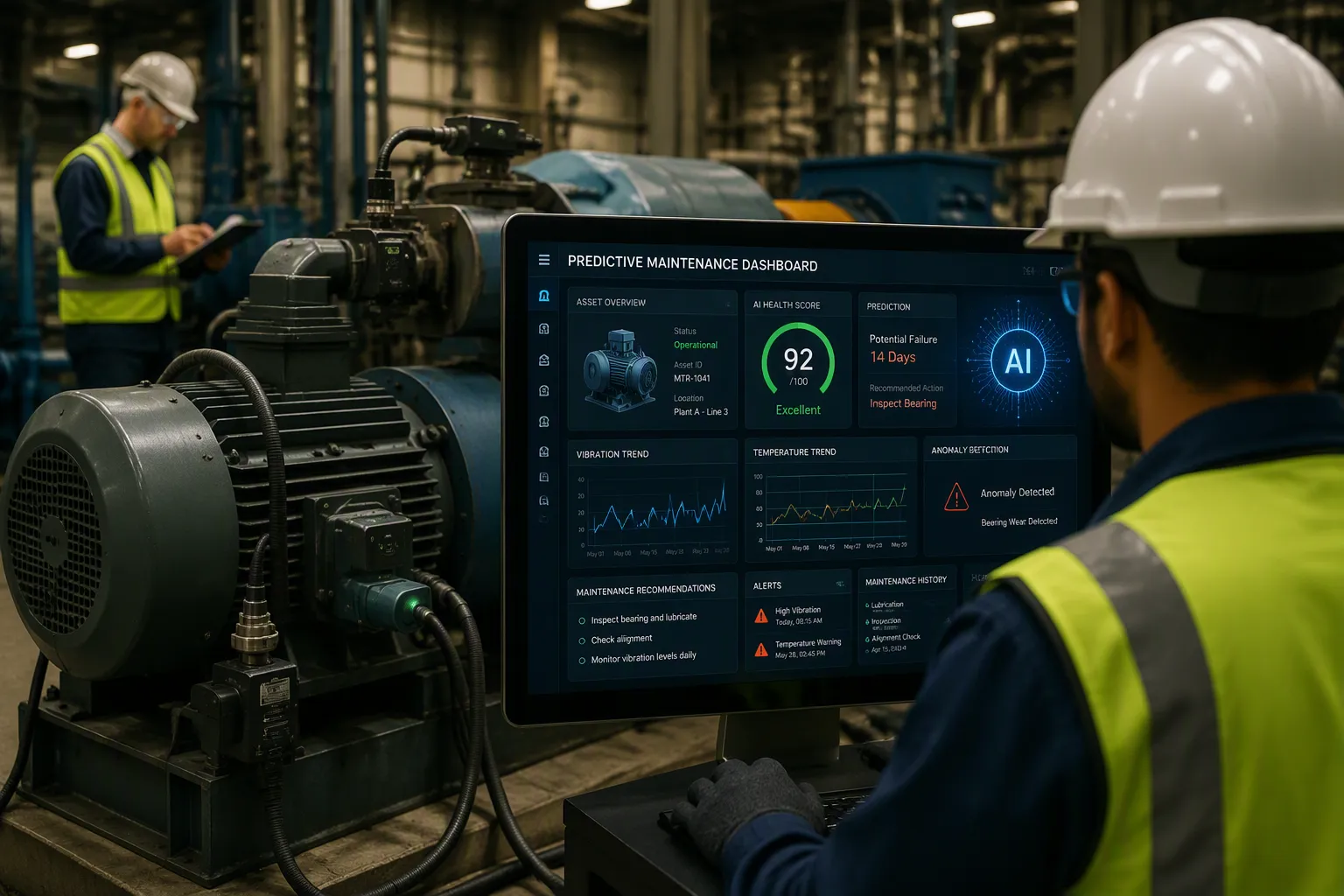
Predictive vs. Preventive vs. Reactive Maintenance
You face three distinct maintenance philosophies. Reactive maintenance means you wait for equipment to break, then fix it. This approach costs you dearly. Emergency repairs run 4.8 times more expensive than planned work. Overtime premiums, expedited shipping, and production losses stack up quickly.
Preventive maintenance improves the picture. You schedule service at fixed intervals—every month, every quarter, regardless of condition. This strategy catches predictable wear patterns. However, it misses failures that develop between scheduled checks. You might replace a healthy bearing while ignoring a failing motor nearby.
Predictive maintenance with ai changes everything. You monitor equipment continuously and fix problems just-in-time. This approach catches 70–75% of unexpected breakdowns and detects faults 2–6 weeks early. Your team performs repairs when condition demands, not when the calendar dictates.
| Dimension | Reactive | Preventive | AI-Powered Predictive |
|---|---|---|---|
| Annual maintenance cost (% of asset value) | 12–18% | 8–12% | 5–8% |
| Downtime reduction vs. reactive baseline | Baseline | 20–35% | 50–70% |
| Labor productivity (wrench time) | 45–55% | 65–75% | 80–90% |
| Prediction accuracy | None | Not self-improving | 88–97%, self-improving |
The cost gap between strategies is striking. Preventive maintenance runs about $127,000 per unit annually. Switching to predictive drops that figure to $84,000—a 34% reduction. One construction fleet of 45 assets saved $287,000 per year after making this transition. Unplanned breakdowns fell 62%.
The Role of AI in Predictive Maintenance Analytics
Traditional maintenance relies on human judgment and fixed schedules. Ai in predictive maintenance replaces guesswork with pattern recognition. Machine learning algorithms analyze historical and real-time data to identify subtle changes that precede failure. This capability forms the core of ai in predictive maintenance.
You feed the system data from multiple sources. IoT sensors measure vibration, temperature, pressure, and fluid levels. Operational logs record run times and load conditions. The ai in maintenance planning system learns what normal operation looks like for each asset.
Three algorithm families power this analysis. Supervised learning trains on labeled data to classify failures or predict remaining useful life. Random Forest, SVM, and Logistic Regression work well here. Unsupervised learning detects anomalies without labeled examples. Autoencoders excel at spotting novel failure modes. Deep learning, especially LSTM networks, captures long-term patterns in time-series sensor data.
The process follows a clear sequence. First, sensors collect high-frequency readings. Second, feature engineering transforms raw streams into useful signals. Third, the model learns a baseline from 30–90 days of healthy operation. Fourth, real-time scoring compares live readings against that baseline every 1–60 seconds. Fifth, a secondary model classifies the anomaly signature—bearing wear, imbalance, misalignment. Finally, the system generates a work order with priority and recommended action.
This predictive analytics approach delivers faster, more accurate failure prediction. You receive actionable recommendations on what to fix and when. The model learns and adapts continuously, improving accuracy as your dataset matures. Your reliability improves because you address problems while they remain small. Your monitoring becomes proactive rather than reactive. This data-driven maintenance strategy transforms how you manage assets across your facility.
How Predictive Maintenance With AI Works
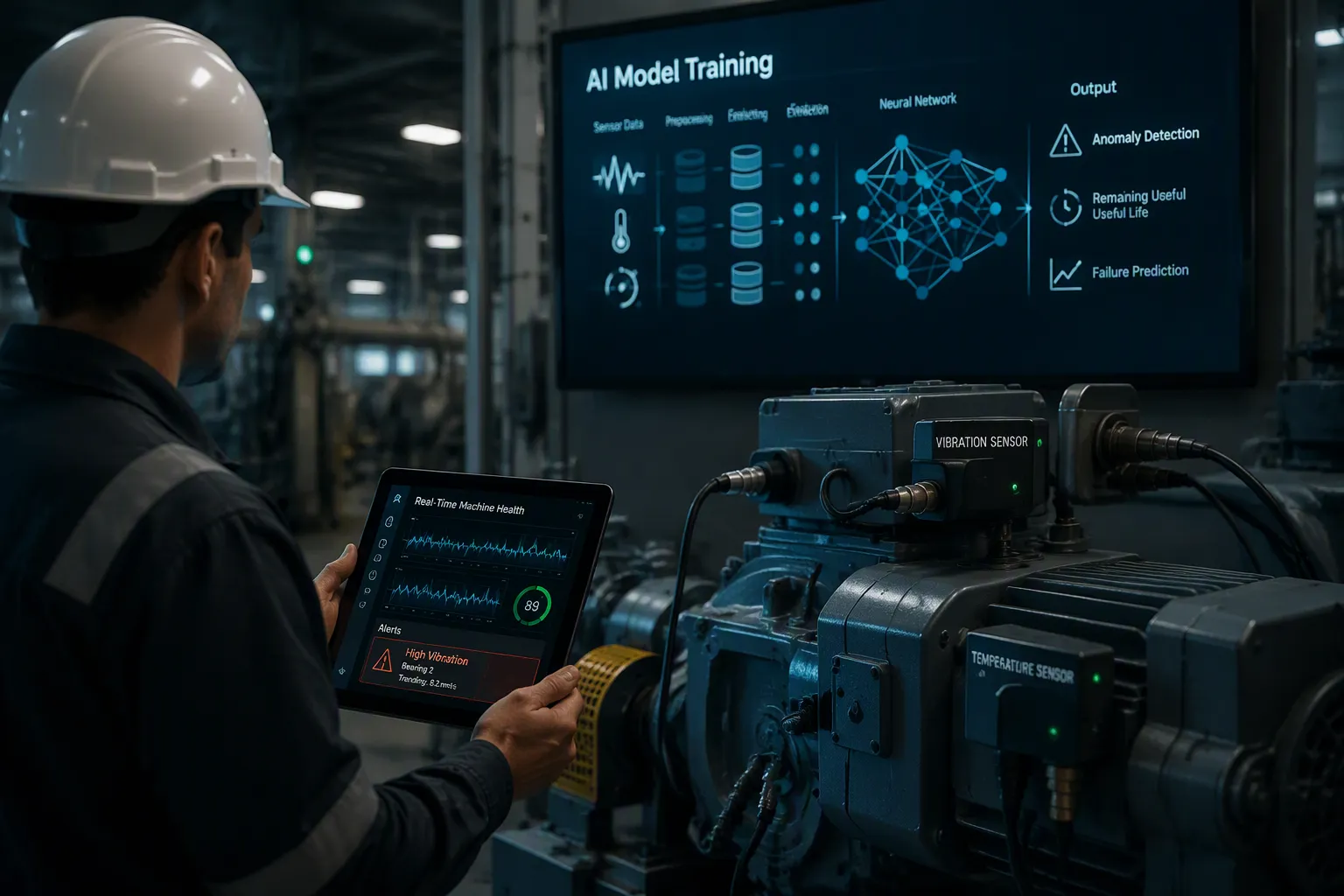
The journey from raw sensor signals to a scheduled repair follows a clear sequence. Each step builds on the previous one. Understanding this flow helps you see where value emerges and where challenges hide.
Step-by-Step Process From Data to Action
Step 1: Data Collection via IoT Sensors
You begin with sensors mounted on critical equipment. Vibration sensors catch bearing wear, misalignment, and imbalance. Temperature sensors detect thermal degradation and lubrication failure. Acoustic sensors pick up subtle changes in sound patterns. These devices capture thousands of data points per minute per sensor. Operational logs add context about run times, loads, and environmental conditions. This high-frequency input forms the foundation for accurate model training.
Step 2: Data Processing and Cleaning
Raw sensor streams contain noise and gaps. You filter this data at the edge device first. Edge computing removes obvious interference and detects preliminary anomalies. Only refined data travels to your central system. Regular audits and cleaning pipelines handle missing values through interpolation techniques. You calibrate sensors regularly and maintain consistent reporting intervals. Clean, well-labeled data directly determines model performance.
Step 3: Model Training on Historical Data
Machine learning algorithms analyze 30–90 days of healthy operation to establish a baseline. They learn the normal operating signature for each asset. LSTM models, a type of deep learning network, excel at capturing long-term patterns in time-series data. These models achieve 94.3% failure prediction accuracy in manufacturing environments when analyzing combined sensor streams. The learning process continues as the system encounters new data.
Step 4: Real-Time Monitoring and Anomaly Detection
Once trained, the model scores live readings every 1–60 seconds. Real-time monitoring compares current behavior against the learned baseline. When patterns deviate, the system flags an anomaly. AI-correlated sensor data enables failure detection 60–90 days earlier than traditional monitoring methods. A secondary model classifies the anomaly signature—bearing wear, imbalance, overheating, or lubrication problems.
Step 5: Alert Generation and Maintenance Scheduling
The system generates a work order with priority and recommended action. Remaining useful life forecasting estimates how long the asset can continue operating safely. This forecasting helps you align repairs with production windows and parts availability. You fix problems just-in-time rather than too early or too late.
A case study from a 24/7 FMCG production line illustrates the mechanism. The company faced unplanned failures every 2–3 weeks. By installing vibration sensors on gearboxes and motors and temperature sensors on bearing housings, they detected early signs of bearing wear in a critical motor. This allowed them to fix the issue before failure, resulting in a 64.42% reduction in unplanned stoppages and achieving ROI in less than 6 months.
Key Technologies: IoT, Machine Learning, and Big Data
Three technology pillars support ai-powered predictive maintenance. Each plays a distinct role in the workflow.
| Sensor Type | What It Catches | Warning Lead Time |
|---|---|---|
| Vibration | Bearing wear, misalignment, imbalance | 4–12 weeks before bearing failure |
| Temperature | Thermal degradation, lubrication failure | 2–8 weeks for thermal anomalies |
| Acoustic | Internal component stress patterns | Varies by application |
Vibration sensors catch 43% of all industrial equipment failures. Temperature sensors catch another 28%. Together, they cover most common failure modes. Modern IoT sensor systems achieve 85–95% accuracy in identifying degradation patterns. False positive rates stay under 5% for properly configured systems.
Big data infrastructure stores and processes the massive volume of readings. Machine learning algorithms extract patterns from this historical record. The ai in predictive maintenance loop closes when completed work orders validate or correct initial predictions. Accuracy improves continuously as the model learns from outcomes.
This entire process enables proactive interventions on high-speed assembly lines and other critical equipment. You prevent failures before they impact production. Your asset condition monitoring shifts from periodic checks to continuous awareness. The result is genuine data-driven maintenance that protects your most valuable assets.
Key Benefits of AI-Powered Predictive Maintenance
Quantifying Value: Cost Savings and Uptime
The numbers tell a clear story. You shift from reactive firefighting to proactive management. The benefits of ai in predictive maintenance touch every part of your operation. Real-time monitoring catches problems early. This approach transforms overall equipment effectiveness.
| OEE Pillar | Before ai | After ai | Improvement |
|---|---|---|---|
| Availability | 82% | 93% | +11 pts |
| Performance | 78% | 88% | +10 pts |
| Quality | 93% | 97% | +4 pts |
| OEE Score | 59.4% | 79.3% | +19.9 pts |
Your OEE jumps nearly 20 points. Availability rises 11 points when ai in predictive maintenance catches failures early. Performance improves 10 points as assets run without interruption. Quality gains 4 points from consistent operation.
Cost savings extend beyond OEE. Worthington Steel applied predictive maintenance with a simple lubrication fix. This action extended a gearbox life by three years. Their return on investment reached 15X. Ai-powered predictive maintenance helps you preserve capital investments. Your assets run longer before needing replacement.
Real-time condition monitoring allows organizations to maintain assets more effectively over time and reduce excessive wear and tear. By constantly tracking lubrication, alignment, temperature and other variables, predictive maintenance helps teams correct problems before they unnecessarily degrade equipment. When assets are maintained predictively instead of through a reactive, run-to-failure approach, they have longer useful lives.
These documented benefits of ai in predictive maintenance make a strong case for adoption. The top benefits of ai-powered maintenance forecasting directly impact your bottom line. You reduce costs and improve reliability simultaneously.
Real-World Proof: Case Studies Across Industries
Real-world examples of ai in predictive maintenance demonstrate proven results across manufacturing and energy.
General Motors deployed ai-powered predictive maintenance at their Arlington Assembly Plant. The plant produces over 1,200 SUVs daily. Breakdowns in welding robots, conveyor belts, and paint shop machinery threatened throughput. GM installed IoT sensors measuring vibration, temperature, pressure, humidity, and electrical current. Their ai system predicted over 70% of equipment failures at least 24 hours in advance. Unplanned downtime dropped. Equipment life extended.
General Electric used ai in predictive maintenance across their facilities. Machine learning analyzed real-time sensor data. The system detected patterns preceding failures. GE reduced unexpected downtime and saved costs.
The energy sector shows the top benefits of ai-powered maintenance forecasting. Wind turbine operators face massive gearbox replacement costs of $250,000 to $400,000 each.
| Metric | Value |
|---|---|
| O&M cost savings | 20-30% |
| Unplanned downtime reduction | 30-50% |
| Gearbox replacement cost avoided | $250K-400K each |
| Offshore vessel campaign reduction | 30-40% |
| Advanced warning for failures | 6-12 months |
| Payback period for onshore fleet | 12-24 months |
| Onshore 250 MW fleet saved | $3.2M |
| Offshore 500 MW fleet campaigns | 22 to 14 |
Ai-powered predictive maintenance cuts downtime by up to 35%. It reduces maintenance costs by up to 25%. An onshore fleet saved $3.2 million. An offshore fleet reduced vessel campaigns from 22 to 14.
These real-world examples of ai in predictive maintenance confirm the pattern. You reduce costs. You extend asset life. You improve reliability. You streamline operations with predictive maintenance as your core strategy.
Overcoming Challenges in Predictive Maintenance Implementation
Navigating Data Quality and Integration Hurdles
Your path to ai-powered predictive maintenance starts with acknowledging real obstacles. Data quality tops the list of common problems for any predictive maintenance program leveraging ai. You face noisy sensor signals and limited historical data. Inconsistent maintenance logs and missing contextual data also block progress. You must tackle integration between legacy systems and new IoT sensors. Older equipment lacks modern communication protocols. You may need protocol converters or retrofits. Data security risks emerge when legacy systems connect to networks. Scalability constraints limit how far you expand your IoT sensor network. These factors drive high implementation costs. You overcome these hurdles through careful planning and ai-driven solutions. Start with clean data management practices. Calibrate sensors regularly. Standardize maintenance logs across your organization. Use edge computing with real-time data filtering to reduce noise. Address compatibility issues one asset at a time using ai systems. This predictive analytics foundation, built on clean data, enables accurate ai forecasting and failure prediction.
Building Skills and Starting With a Pilot Program
A shortage of data science talent often blocks progress with ai-powered predictive maintenance. You solve this through a multi-pronged workforce strategy. Provide technical training for data scientists on ai platforms. Offer operational training for maintenance technicians to interpret predictive alerts. Build cross-functional teams that include data scientists, IT professionals, reliability engineers, and experienced technicians. This fusion of data science with domain knowledge drives results for predictive maintenance. Allocate 10-15% of your budget to workforce development and ai skill building. Use no-code ai platforms so maintenance teams build custom models. Ai and machine learning tools enable better optimization of maintenance schedules.
Start your predictive maintenance journey with a small pilot program. Build a small team including maintenance engineers, a project lead, data science expertise, and IT staff. Select a pilot site with a culture open to improvement. Focus on one site to concentrate budget and sensors. Choose about 5% of total site assets. This increases your chance of capturing a failure within the 60-90 day pilot window. Deploy sensors with a ratio of approximately 1.4 sensors per asset for rotating equipment. Establish a baseline by documenting 12 months of failure costs and downtime for target assets. Use conservative estimates when calculating prevented costs. Monitor alert accuracy and maintenance impact. Compare failures, downtime hours, and repair costs against your written baseline after six months. This real-time data comparison validates your ai predictive model.
This phased approach proves value before you scale. You build confidence through real results. Your streamline operations with predictive maintenance initiative grows naturally from demonstrated success. You use ai in maintenance planning from the start. Real-time monitoring catches problems early. The ai learning system improves as your dataset matures. Your continuous learning loop drives ongoing reliability gains.
AI-powered predictive maintenance transforms your operation from reactive firefighting to proactive, data-driven asset management. You reduce downtime, cut costs, and boost productivity through continuous monitoring and learning. This predictive approach prevents failure before it disrupts production.
The benefits are clear, yet implementation demands strategy, quality data, and expertise. Start small. Audit your current maintenance processes. Identify one high-value asset for a pilot program. This ai-powered predictive maintenance journey begins with one step.
The future brings digital twins and edge AI. IoT sensors feed richer data streams. Real-time forecasting becomes standard practice. Your reliability improves with each cycle. Predictive analytics will only grow smarter with ai.
Take action today. Begin your journey toward smarter maintenance.
FAQ
How quickly do companies see returns from a predictive maintenance program?
Most achieve a positive return within 6–12 months. Your operating expenses drop as unplanned downtime falls. This ai-powered approach pays for itself quickly. Document your baseline costs first.
Which equipment problems does predictive maintenance catch best?
Vibration sensors catch 43% of failures. Temperature sensors catch another 28%. Real-time monitoring with ai detects issues weeks early. Focus this predictive approach on rotating equipment first.
How much data do you need to start?
You need 30–90 days of healthy operation data. The learning model improves as your dataset grows. Clean, well-labeled data directly determines model accuracy. Start with a single asset.
Can you use IoT sensors on older equipment?
Yes. Retrofit existing machines with IoT sensors. Use protocol converters to connect legacy systems. Start your predictive maintenance journey without replacing equipment.
What skills does your team need for a predictive maintenance program?
You need data scientists and maintenance technicians working together. Cross-functional teams deliver the best results. Start with a small pilot to build ai expertise gradually.
See Also
Artificial Intelligence For Textile Equipment Care In 2025
Using AI To Improve Production Forecast Precision: 2024 Corporate Tips
Predicting Customer Demand Using AI And Analytics In 2025
Data Driven Inventory Replenishment Strategies For Retailers In 2025
Machine Learning Anticipates Fashion Trends And Increases Revenue