What is a Robotic Picking Arm? Use Cases & Limits
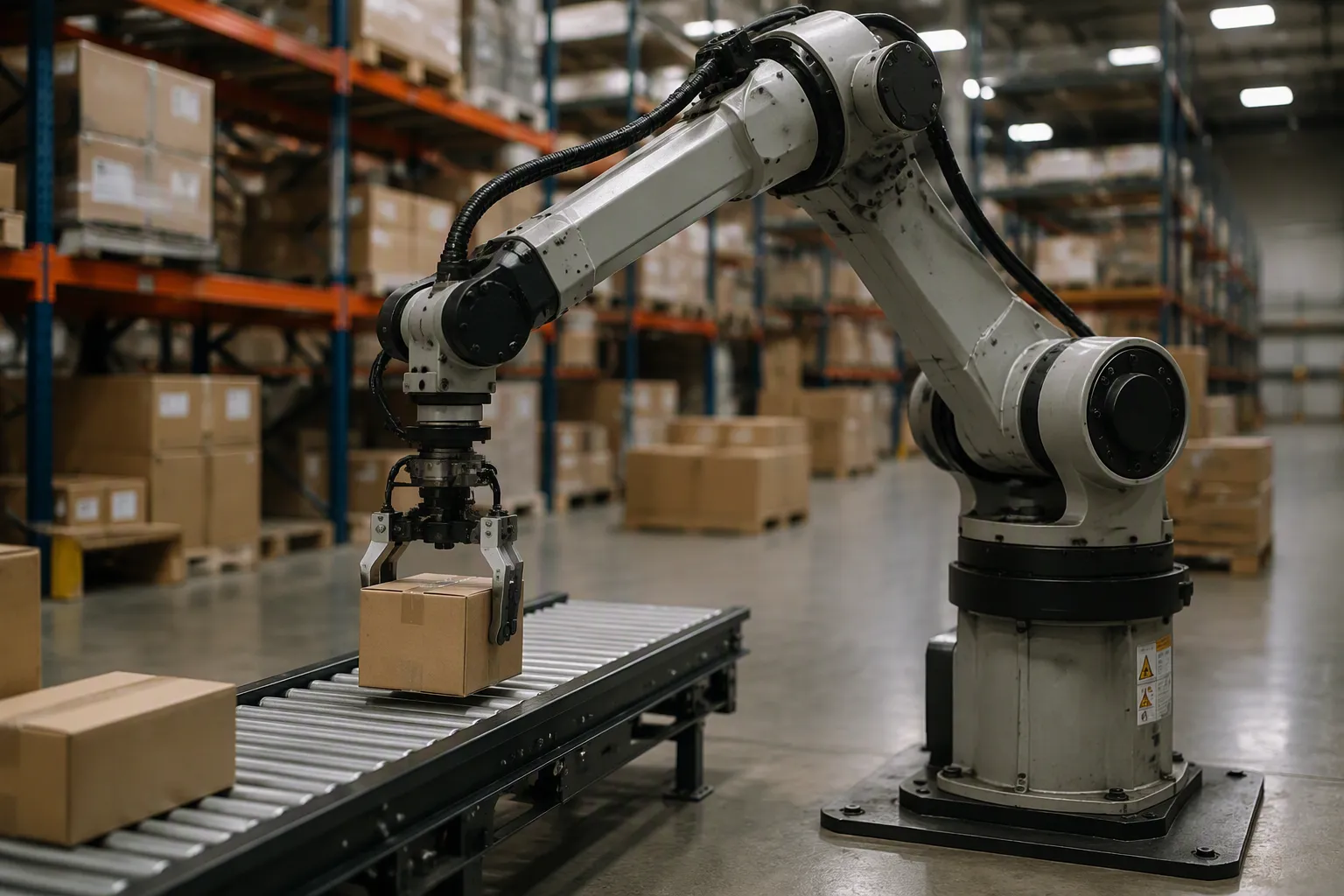
A robotic picking arm is a programmable manipulator. It grasps items and moves them from one place to another. Motors drive its joints, and software directs every motion. You can program it to repeat the same task thousands of times.
This article explains how these machines work. You will learn about their types, real-world applications, and limits. Robotic picking arms boost speed and accuracy across many industries. Yet they also carry constraints. Payload, reach, cost, and safety all shape what a system can do. Understanding those trade-offs helps you choose the right tool for your operation.
How Robotic Picking Arms Work
Core Function and Basic Mechanics
Every robotic picking arm follows the same four-step cycle: detect, grasp, move, and release. First, sensors or cameras locate the target item and confirm its position. Next, the gripper closes around the object with the right amount of force. The arm then moves the item along a planned path to its destination. Finally, the gripper opens and releases the object. You can program this cycle to repeat without breaks, which lets the arm run 24/7.
The number of axes determines what the arm can do. A 5-axis arm moves in five directions and handles single-plane tasks well, such as picking items from a conveyor and placing them on a shelf. A 6-axis arm adds rotation for complex movements, including reaching around obstacles or tilting a part during assembly. Many arms also collect data during operation. That data supports inventory management and route optimization, so you know what moved, when, and where it went.
Key Components: Vision, Grippers, and Software
A vision system gives the arm its eyes. Cameras and sensors identify items by shape, size, or barcode, even when objects sit in a cluttered bin. This accuracy matters for pick and place automation, where a wrong grab wastes time and can damage products.
Interchangeable grippers, also called end-of-arm tooling, let one arm handle very different jobs. You might switch to a vacuum cup for flat boxes, a two-finger gripper for small parts, or a soft gripper for fragile produce. Intelligent software ties everything together. It plans motion paths, adjusts grip force, and learns from each cycle to improve accuracy over time.
Types of Robotic Picking Arms
Articulated, Delta, and SCARA
Articulated arms dominate industrial settings. A 6-axis articulated arm bends and rotates like a human arm, so it reaches around obstacles and tilts parts during assembly. These robotic arm types handle complex movements well. Their pick rates typically fall between 20 and 60 picks per minute. Modern articulated robots range from compact tabletop units with 500 mm reach and 3 kg payload up to heavy-duty machines exceeding 3 meters of reach and 500 kg payload. You can also find 5-axis versions for single-plane tasks.
Delta robots trade flexibility for speed. Three or four lightweight arms connect to a single base, and the design delivers blazing fast motion. Delta robots are rated up to roughly 220 picks per minute. That speed suits high-volume sortation and food packaging. SCARA arms combine speed with precision. They move in a horizontal plane and excel at assembly. Their repeatability reaches ±0.01 mm for precision pick-and-place and ±0.01 to ±0.02 mm in collaborative operation.
| Robot Type | Peak Pick Rate (picks/min) |
|---|---|
| Delta | 150-300 |
| 6-Axis Articulated | 30-60 |
Cartesian and Collaborative Robots
Cartesian arms move along linear axes. They are simple, rigid, and easy to program. A Cartesian gantry handles straightforward pick-and-place tasks with end-effector speeds of 1 to 2 m/s. SCARA arms reach 5 to 8 m/s, and delta robots exceed 10 m/s. In a small electronics pick-and-place setup using a Yamaha-style Cartesian gantry, the X-axis carriage is driven by a 1610 ball screw with a NEMA 23 servo, where amax = 5 m/s² and vmax = 1.0 m/s.
Collaborative robots, or cobots, work safely alongside people. They feature rounded edges and low payloads. The UR3e carries 3 kg, the UR7e handles 7 kg, and the UR10e manages 12.5 kg. The UR16e lifts 16 kg. ABB GoFa models range from 5 kg to 12 kg. FANUC CRX models reach 20 kg and 25/30 kg. These payload limits let workers guide the arm by hand. Cobots must follow ISO 10218-1 and ISO 10218-2. A supplier's ISO 10218-1 certification covers only the arm, not your application. You still need an ISO 10218-2 assessment informed by ISO/TS 15066.
Key Use Cases for Robotic Picking Arms
Factory Automation and Precision Handling
Factories deploy robotic picking arms for assembly, inspection, packaging, and machine tending. High-speed pick-and-place supports fast assembly lines and sortation systems. A delta robot rated at 150 to 300 picks per minute keeps pace with rapid production schedules. An articulated arm with six axes handles complex assembly tasks that require tilting and rotating parts.
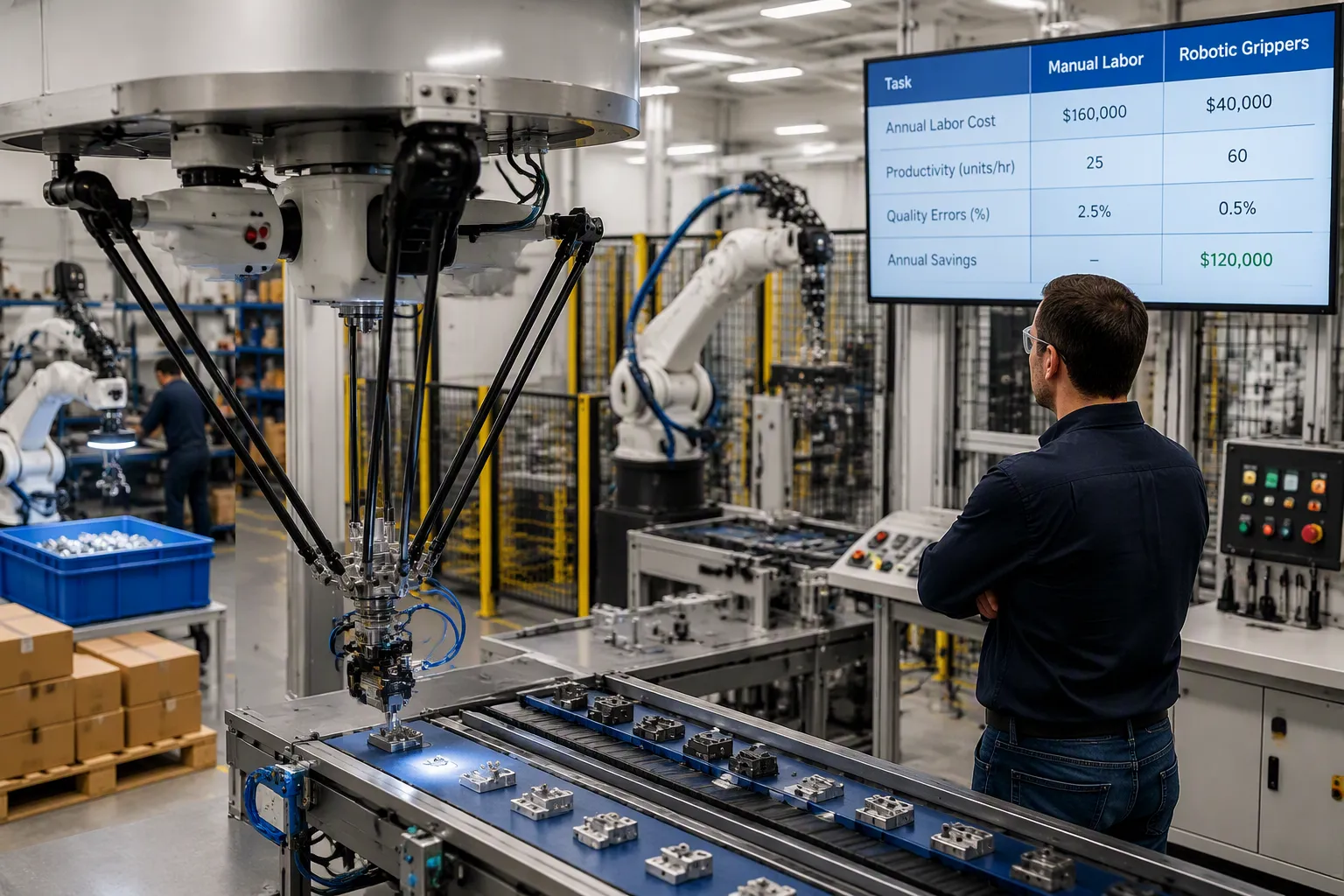
Machine tending offers one of the clearest financial cases. A single automated workstation replaces four full-time equivalents across two shifts. Manual labor costs run about $160,000 to $260,000 each year. With two robot arms and one supervisor, annual labor costs drop to roughly $40,000. Pneumatic grippers cost just $80 to $500 per unit, while electric servo grippers run $2,500 to $7,000. Annual maintenance adds only $500 to $1,200. Over five years, one automated workstation saves $500,000 to $1,000,000 in direct labor costs.
| Cost Factor | Manual Labor | With Robotic Pneumatic Grippers |
|---|---|---|
| Workstations Covered | 4 FTE (2 operators × 2 shifts) | 2 robot arms + 1 supervisor |
| Annual Labor Cost | ~$160,000 – $260,000 | ~$40,000 (supervisor) |
| Gripper Hardware (one-time) | N/A | $1,600 – $4,000 |
| Annual Maintenance | Included in labor | ~$500 – $1,200 |
| Annual Labor Savings | — | $120,000 – $220,000 |
| Payback Period | — | 3 – 8 months |
Warehouse, Agriculture, and Quality Control
Warehouses rely on robotic picking arms for bin picking, palletizing, and order fulfillment. Vision-guided bin picking systems achieve positional accuracy within plus or minus 1 to 3 millimeters. That precision suits most industrial gripping tasks. Pick success rate varies with part geometry, surface finish, and bin fill level. A well-configured system dedicated to one part type reaches production-grade reliability. Failed picks trigger an automatic move to the next-ranked grasp candidate.
Typical automated picking accuracy rate: 99.9%+
Agriculture uses these arms for planting, spraying, and harvesting. Strawberry harvesting stands out as a demanding application. The fruit bruises easily, so soft grippers and vision systems must work together. Quality control relies on vision-guided inspection. Cameras check dimensions, surface defects, and assembly completeness at production speed.
The benefits of pick and place robots extend across all these settings. You gain consistent throughput, reduced waste, and data you can act on. Payback periods for material handling systems range from 10 to 18 months. General automation investments typically return in 12 to 24 months. High-volume facilities where labor costs exceed $18 per hour see payback in 12 to 18 months. The Boston Consulting Group found a 10 to 15 percent ROI within the first year and 20 to 25 percent within three to five years. The Robotics Industries Association reports a median ROI of 1.3 years.
Limits and How to Choose
Physical and Financial Constraints
Every robotic picking arm carries trade-offs. You must match the machine to your application. Payload capacity sets the first limit. Small collaborative arms lift just 3 kg. Large industrial arms handle several hundred kilograms.
For applications above 1,000 kg, the field narrows to a handful of robot models from FANUC, KUKA, and ABB. At these payload classes, the robot itself weighs several tons, and installation requires reinforced concrete foundations engineered specifically for the dynamic loads involved.
The Kawasaki MG15HL handles 1,500 kg with a 4,005 mm reach. The Kawasaki M series ranges from 350 kg to 1,500 kg for heavy-duty general purpose work. EVST offers a 6-axis robot range from 6 kg to 800 kg. Four-axis palletizers reach up to the 800 kg class.
Reach matters as much as payload. A short arm cannot serve a wide workspace. Speed also varies. Delta robots exceed 150 picks per minute. Articulated arms move slower but handle complex paths. Repeatability determines precision. SCARA arms achieve ±0.01 mm for assembly tasks. You pay for every capability increase.
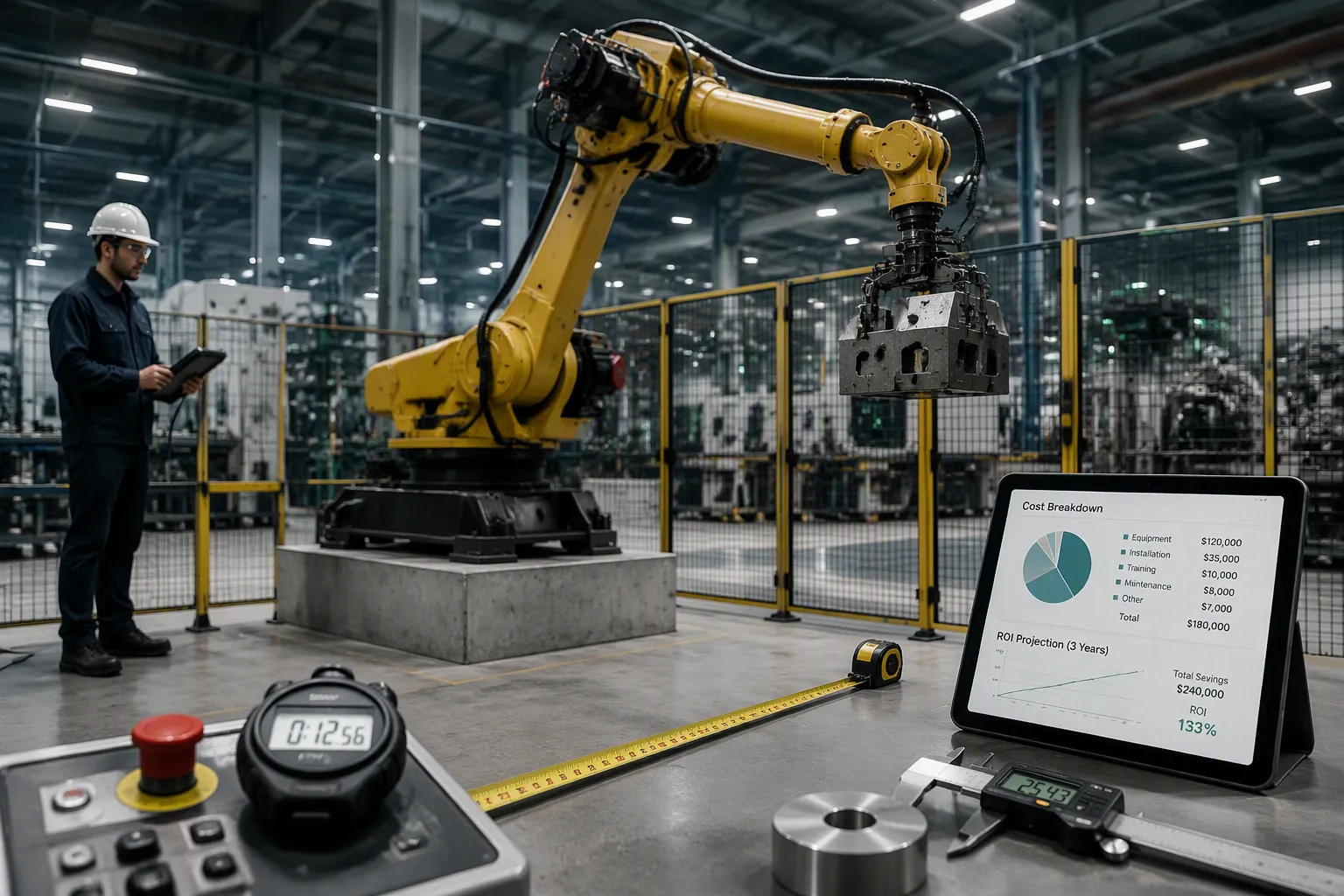
Cost breaks into two parts: upfront hardware and long-term operation. A basic gripper costs $80 to $500. An electric servo gripper runs $2,500 to $7,000. Maintenance adds $500 to $1,200 each year. The real question is return on investment. According to Buske Logistics, most operators targeting high-volume fulfillment achieve payback on robotic picking arms within 2 to 4 years, when labor savings, reduced error costs, and throughput gains are combined. High-volume, fast-moving operations tend to see faster payback. Factors such as order volume, local labor market conditions, and system uptime affect the actual timeline. You should calculate your own numbers.
The benefits of pick and place robots include consistent throughput and reduced waste. But those benefits only matter if the machine fits your physical constraints first.
Integration, Safety, and Future Trends
Integration poses a second set of limits. Programming a robotic arm requires specialized skills. Some arms use pendant programming. Others rely on offline software. Either way, you need trained staff or a system integrator. The learning curve can delay deployment by weeks. You must also plan for network connections and data collection. The arm feeds information into your inventory system. That integration takes time to set up correctly.
Safety introduces another constraint. Traditional industrial arms need safety cages. These barriers protect workers from fast-moving machinery. Collaborative robots remove the cage. They follow ISO 10218-1 and ISO 10218-2 standards. A supplier's ISO 10218-1 certification covers only the arm, not your application. You still need an ISO 10218-2 assessment informed by ISO/TS 15066. Cobots work alongside people but carry lower payloads. The UR3e lifts 3 kg. The UR16e manages 16 kg. You trade speed and strength for safety. Evaluate your facility layout before choosing between caged and collaborative setups.
Future trends address these limits. Artificial intelligence improves vision systems. Machine learning helps arms adapt to new parts without reprogramming. AI can plan better grasp points for irregular objects. These advances reduce programming time and improve pick success rates. Manufacturers also develop higher-payload collaborative arms. The trend narrows the gap between industrial and collaborative robots. AI-driven path planning also optimizes motion to reduce cycle time. You benefit from faster deployment and lower integration costs.
You must evaluate your own needs. Match payload, reach, and speed to your parts. Calculate ROI against your labor costs and volumes. Plan for integration time and safety compliance. The right choice balances capability against cost.
Robotic picking arms boost throughput and consistency across manufacturing, warehousing, and agriculture. You gain speed, precision, and around-the-clock operation. You must weigh payload, reach, cost, and safety against your specific application. The right machine fits your parts, your budget, and your facility layout. Calculate ROI from your labor expenses and production volumes. Plan for integration time and safety compliance. AI and collaborative advances continue to expand what these arms can do. Higher payload cobots and smarter vision systems reduce previous adoption barriers. These trends broaden access across more industries every year. You should evaluate your needs against every limit discussed. Match the tool to the task for best results.
FAQ
What is the difference between a 5‑axis and a 6‑axis arm?
A 5‑axis arm handles single‑plane tasks like moving items from a conveyor to a shelf. A 6‑axis arm adds rotation. This lets it reach around obstacles or tilt parts during assembly.
Can a picking arm handle fragile items?
Yes. Soft grippers and vision systems let the arm handle delicate items without damage. Agricultural robots pick strawberries using this technology.
How long does it take to recover the investment?
Payback varies by application. High‑volume fulfillment often sees payback in 2 to 4 years. Material handling systems typically return the investment in 10 to 18 months.
Do collaborative robots need safety cages?
No. Cobots follow ISO 10218 standards and work alongside people without cages. This safety comes with trade‑offs. Cobots carry lower payloads and move slower than industrial arms.
What happens when the arm fails to pick an item?
The system automatically moves to the next best grasp candidate. A properly configured arm dedicated to one part type reaches production‑grade reliability.
See Also
How Using Pick Lists Can Improve Warehouse Efficiency
Achieving Greater Efficiency Through Pick To Cart Systems In 2025
How New Technologies Are Changing The Way Material Handling Works
Using Demand Driven AI For Production Scheduling In 2025
How Smart Ecommerce Warehouse Strategies Can Maximize Overall Efficiency